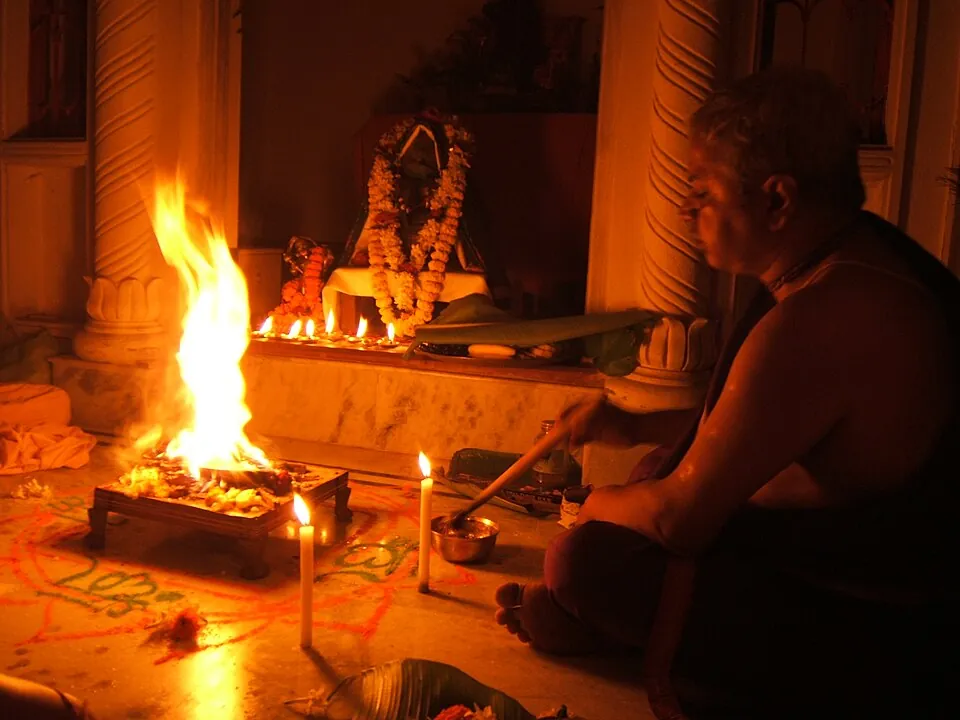
The Agnihotra, Daily Fire Offering of Vedic Households
Agnihotra · अग्निहोत्र
Agnihotra is a Vedic fire ritual in which ghee, and in some forms heated milk, is offered into a sacred fire at dawn and dusk. It was the simplest public śrauta rite, practised across Indo-Iranian traditions and still performed in South Asia today.
The Agnihotra is the offering of ghee, and in some versions heated milk, into a consecrated fire according to strict ritual rules, traditionally morning and evening. It belongs to the śrauta tradition, in which priests recite verses from the Ṛgveda while performing the rite. Scholars such as P. E. Dumont have read it both as a charm for fertility and as a charm of the sun, since the evening and morning offerings were thought to protect the sun through the night and bring it back at sunrise. In the Vedic period it was the simplest public ritual, and the head of every Brahmin and Vaiśya household was expected to carry it out twice each day. The practice already enjoyed wide popularity by the time of the Upaniṣads. It appears to share roots with an older Indo-Iranian inheritance, since the Zoroastrian Yasna Haptaŋhāiti in Old Avestan is a related form of fire worship. Today the rite continues in many parts of South Asia, chiefly in India and Nepal, and the priest who performs it is known as an agnihotrin. The date shown is a rough scholarly marker for the Vedic age.