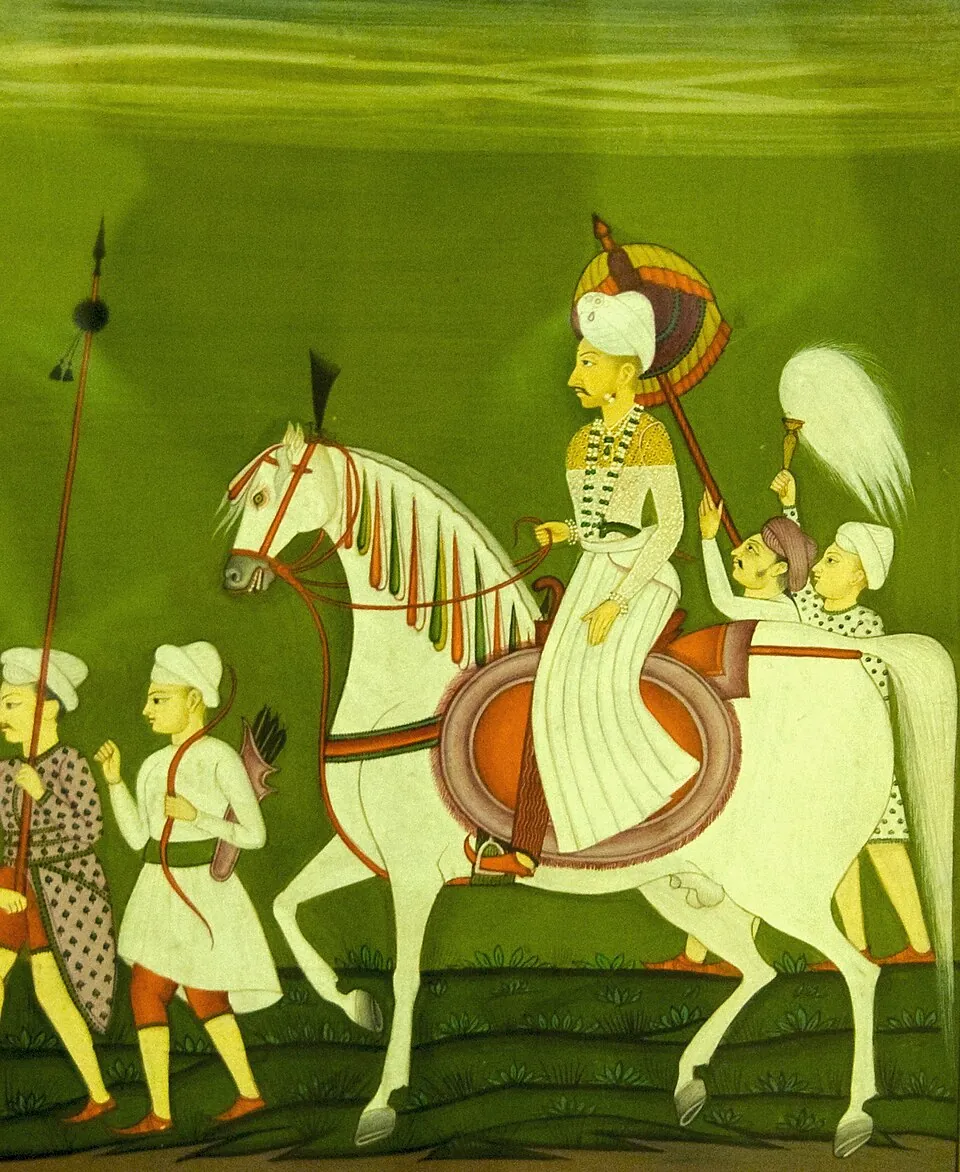
Balaji Baji Rao Leads the Maratha Confederacy
Bālāji Bājī Rāv · बालाजी बाजीराव
Balaji Baji Rao, called Nana Saheb I, became the eighth Peshwa of the Maratha Empire in 1740, following his father Bajirao I. Under his twenty-year administration real power rested with the Peshwa, the empire became a confederacy, and Maratha territory reached its greatest extent.
Balaji Baji Rao, popularly Nana Saheb I, was born in 1720 and followed Bajirao I, his father, into the Peshwa's office in 1740, holding the office until his death in 1761. During his tenure the Chhatrapati was largely a titular head while real authority lay with the Peshwa. The empire evolved into a confederation in which great houses, namely the Holkars, the Scindias and the Nagpur Bhonsles, held semi-autonomous power. With the help of his cousin Sadashivrao Bhau he introduced a number of fiscal and administrative reforms. Under him the empire stretched from Peshawar in the north-west to Srirangapatna in Karnataka and eastward to Midnapore in Bengal, its widest extent. He sponsored canals, bridges, temples and rest houses for travellers, above all in Pune, the capital. His reign saw Maratha dominance over the Mughals, the Nizam of Hyderabad and the Nawab of Bengal, while Afghan control of Punjab was weakened and the Rajput and Rohilla states were subdued. The expansion ended abruptly at the third Battle of Panipat in 1761, which was a heavy defeat for Maratha forces, and he died soon after.
Sources
- Balaji Baji Rao Wikipedia · CC-BY-SA-4.0
- Q3629888 Wikidata · CC0-1.0