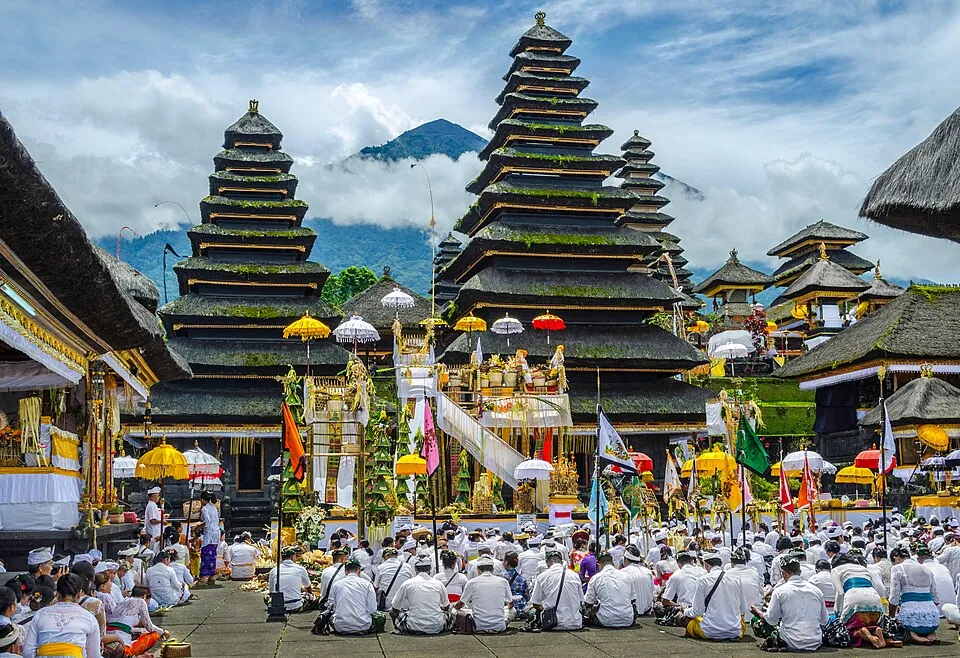
Balinese Hinduism Takes Root in Bali
Bali Hindū · बालि हिन्दू धर्म
Balinese Hinduism, practised mostly on the Indonesian island of Bali, grew from a long blending of local beliefs with Hindu traditions that reached the archipelago from the early centuries CE. Inscriptions from around 914 CE show Hindu-Buddhist rule on Bali, and the faith has its own rites and sacred geography.
Balinese Hinduism, known locally as Agama Hindu Dharma, is a separate form of the religion followed mostly on the Indonesian island of Bali. It is the product of a long process of religious blending in which indigenous Balinese beliefs merged with Hindu traditions that spread through the archipelago from the early centuries CE. It is therefore not a simple continuation of Indian Hinduism but a locally evolved system shaped by temple ritual, village and clan organisation, and a sacred landscape of mountains, lakes and sea. Early written evidence for Hindu and Buddhist practice on the island comes from inscriptions, among them the Belanjong pillar at Sanur, dated about 914 CE, which records the rule of a king named Śrī Kesari Warmadewa. In later centuries, as Hindu-Javanese courts of Majapahit declined on Java, many priests, artists and nobles moved to Bali, which strengthened its Hindu character. Today the religion is the majority faith of the province of Bali, and its festivals, dance and offerings are central to island life. The date used here marks the first firm epigraphic evidence, not the origin of the tradition.
Sources
- Balinese Hinduism Wikipedia · CC-BY-SA-4.0
- Q4850935 Wikidata · CC0-1.0