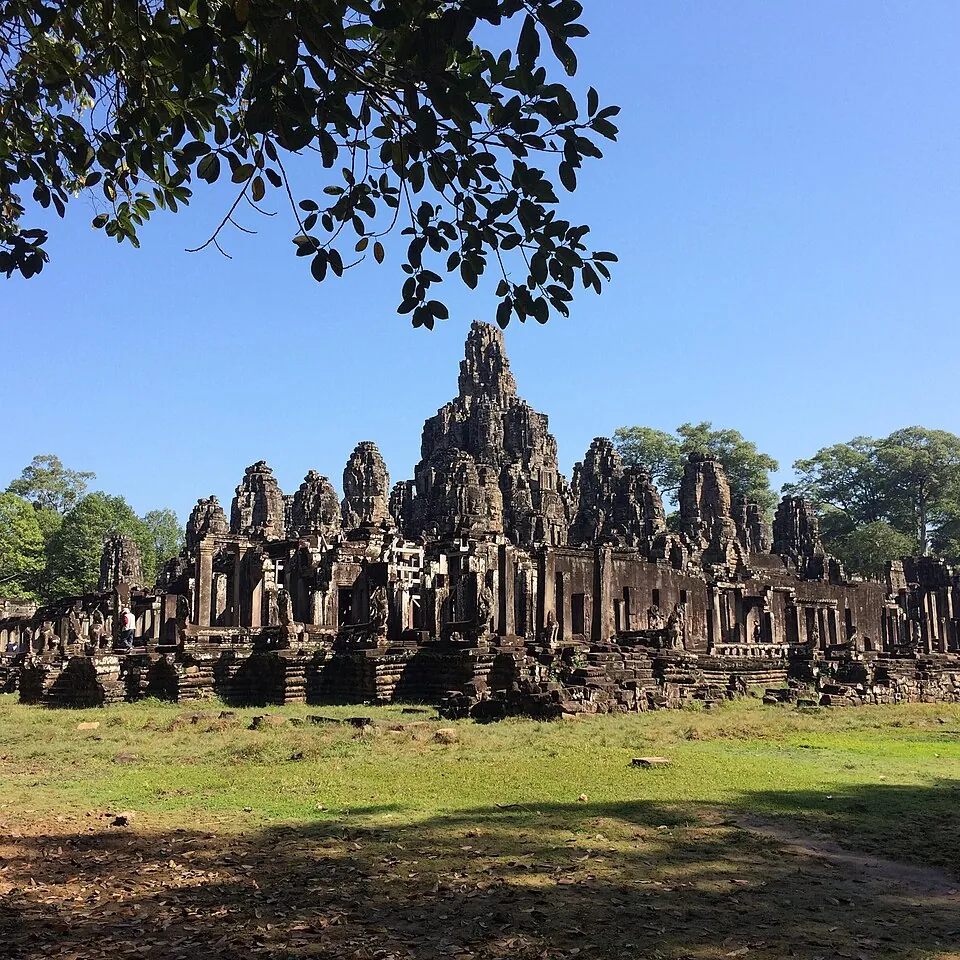
The Bayon, State Temple of Jayavarman VII at Angkor
Bayon · បាយ័ន
The Bayon, built in the late twelfth or early thirteenth century, was the state temple of the Khmer king Jayavarman VII at the centre of Angkor Thom in Cambodia. Conceived as a Mahāyāna Buddhist monument, it is famed for its many towers with large carved faces.
The Bayon is an ornate Buddhist sanctuary within the Khmer realm, found at Angkor, Cambodia. Raised around 1200 as King Jayavarman VII's state temple, it occupies the middle of his capital, Angkor Thom. Its design reflects the strongly Buddhist character of his reign. It was first planned as a Mahāyāna monument focused on the bodhisattva of compassion, and it was later adapted when Theravāda Buddhism spread through Cambodia. Its sculptures, layout and stress on compassion and kingship show how closely religion and royal authority were bound together at Angkor, while the temple's continued use as a Buddhist sanctuary shows how lasting that influence has been. Visitors know it above all for its many towers carved with serene, large faces, and for extensive bas-reliefs showing both scenes of daily life and historical battles. Although it lies outside the subcontinent, the Bayon belongs to the wider Indian-influenced world of Southeast Asia, where Indian religious ideas and artistic forms were reshaped by local rulers over many centuries.