Borobudur Rises in Central Java
Borobuḍur · बोरोबुदुर
Borobudur, a Mahāyāna Buddhist monument in Central Java, was built under the Śailendra dynasty around the eighth to ninth century. Its nine stacked platforms, 2,672 relief panels and many Buddha statues form a pilgrim's path toward enlightenment, linking Indian Buddhist ideas with Javanese tradition.
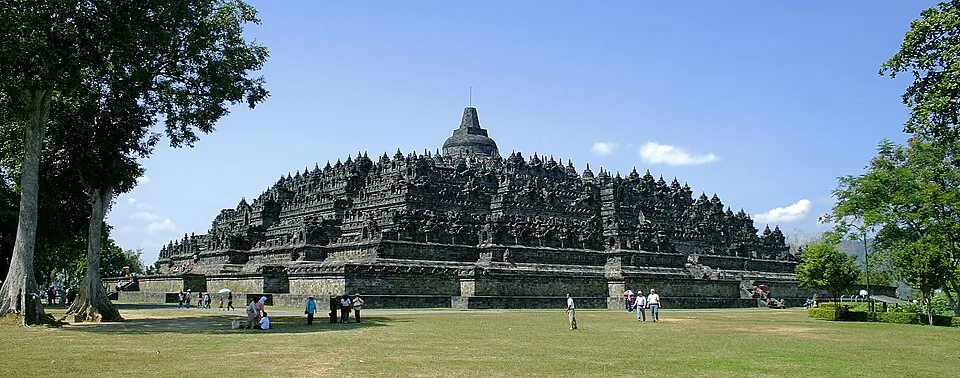
Borobudur stands in Magelang Regency in Central Java, northwest of Yogyakarta. Built of grey andesite-like stone, it rises in nine tiers, the lower six square and the upper three round, with a dome at the summit. Its walls carry 2,672 relief panels, and it originally held 504 Buddha statues, with seventy-two more seated inside perforated stupas around the dome. Pilgrims move up through stairways and galleries lined with 1,460 narrative panels, a vast visual library of Buddhist stories. The temple was raised during Śailendra rule, and its design reflects Javanese Buddhist architecture, which merges local ancestor-veneration with the Buddhist goal of nirvāṇa. Evidence suggests construction began in the eighth century; later it was left abandoned as Hindu kingdoms declined in fourteenth-century Java and the island turned to Islam. Its existence became known worldwide in 1814, when Thomas Stamford Raffles, then British administrator of Java, was told of the site by local people. Borobudur shows how Indian religious and artistic forms travelled across the ocean and were reshaped in Southeast Asia.