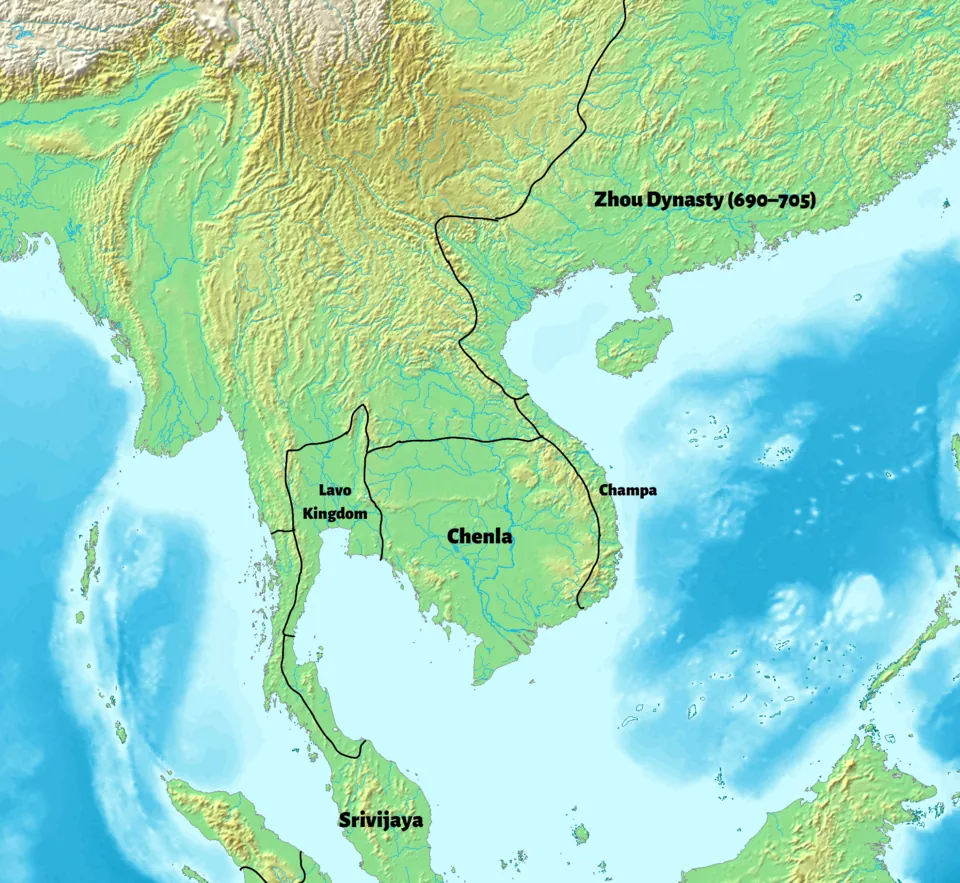
Chenla, the Pre-Angkor Khmer Polities
Zhenla · เจนละ
Span of the Pre-Angkor period, late sixth to early ninth century; boundaries are approximate.
Chenla, or Zhenla, is the Chinese name for the polities that preceded the Khmer Empire from the late sixth to the early ninth century. Modern historians doubt that it was ever one unified kingdom and often describe a shifting set of principalities that grew out of the vassalage to Funan.
Chenla, written Zhenla in Chinese records, is the label used for the early Khmer-speaking states of mainland Southeast Asia that arose after the decline of Funan and before the Khmer Empire of Angkor. Chinese chroniclers began using the name in the late sixth century, and the term survived for centuries; the envoy Zhou Daguan still used it in the thirteenth century when he wrote about Cambodian customs. Modern scholars restrict it to the Pre-Angkor period, from the late sixth to the early ninth century. Whether Chenla ever formed a single kingdom is doubtful. Most historians now argue that the Chinese picture is a simplification and that the area was divided into loose and short-lived confederations of principalities. Rulers such as Īśānavarman I, who built a capital at Īśānapura, are known from Sanskrit and Khmer inscriptions, and they promoted Hindu cults, especially of Śiva and Viṣṇu, alongside Buddhism. The period is significant because it established the religious and political patterns, and the language of inscription, from which the Angkorian state later developed. Dating is therefore approximate and refers to a long period rather than to a single event.