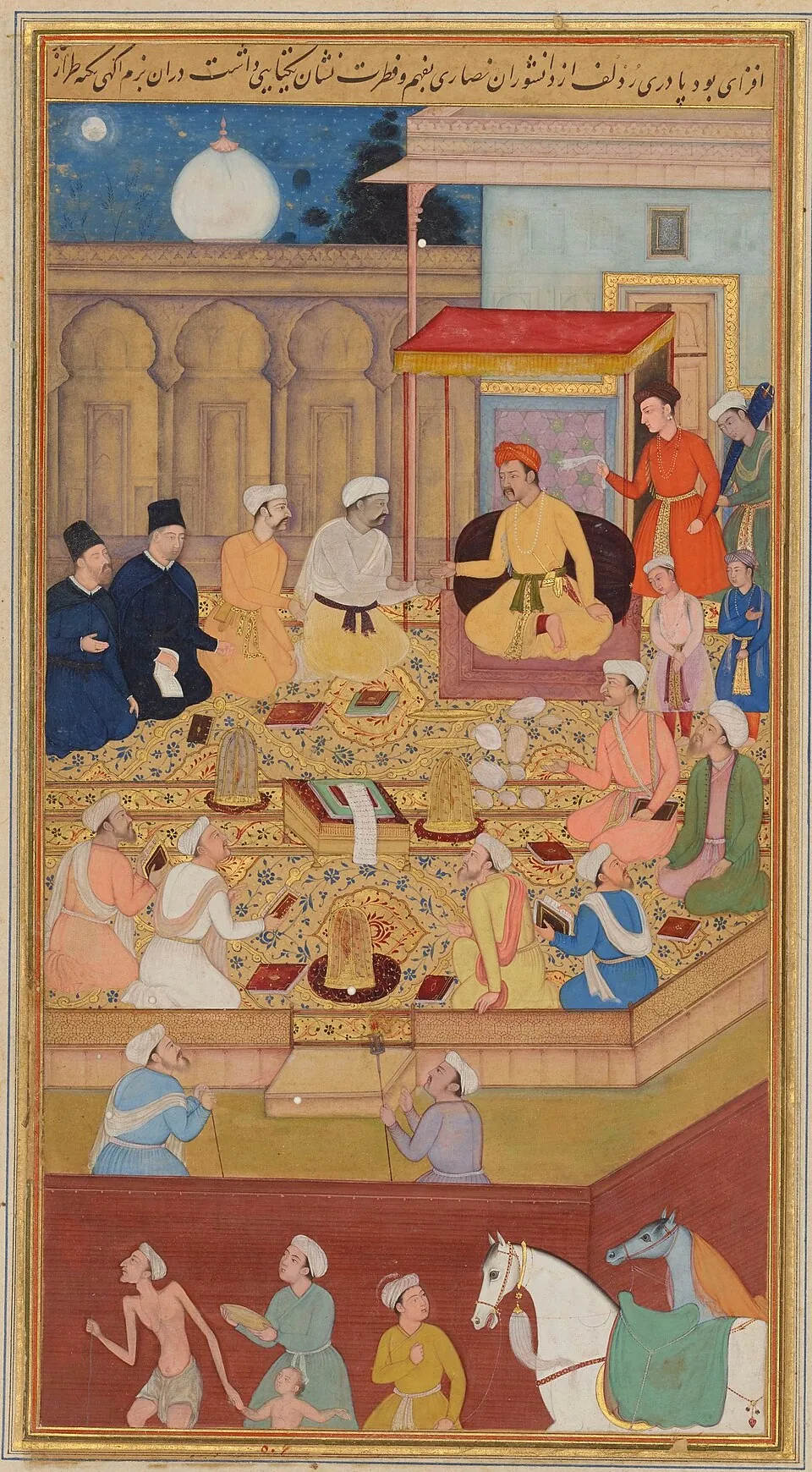
Akbar's Ibādat Khāna at Fatehpur Sikri
In 1575 the Mughal emperor Akbar had the Ibādat Khāna, or House of Worship, built at Fatehpur Sikri. At first it hosted Muslim scholars and divines; from 1578 he also invited Hindu, Jain, Zoroastrian and Christian representatives to debate. Court chroniclers present the sessions as nudging Akbar toward a broad, inclusive outlook.
The Ibādat Khāna, meaning House of Worship, was an assembly hall that the Mughal emperor Akbar, who reigned from 1556 to 1605, had constructed in 1575 at Fatehpur Sikri. Akbar was curious about the beliefs of others, and the hall became a venue where religious and learned men could present their positions before him. The early meetings drew mainly Muslim theologians and mystics, whose quarrels often grew heated. From about 1578 the emperor opened the gatherings to representatives of other traditions, among them Hindu scholars, Jains, Zoroastrians and Jesuit missionaries from Goa, and some accounts mention sceptics as well. Akbar himself presided over the exchanges. Historians link these assemblies to his later policy of reconciling communities, often called sulh-i-kul, and to his experiments with a more universal religious outlook. Much of what is known comes from chronicles written by people close to the court, such as Abu'l Fazl, so descriptions of the debates and their effects should be read with care rather than taken as neutral records.
Sources
- Ibadat Khana Wikipedia · CC-BY-SA-4.0
- Q4021737 Wikidata · CC0-1.0