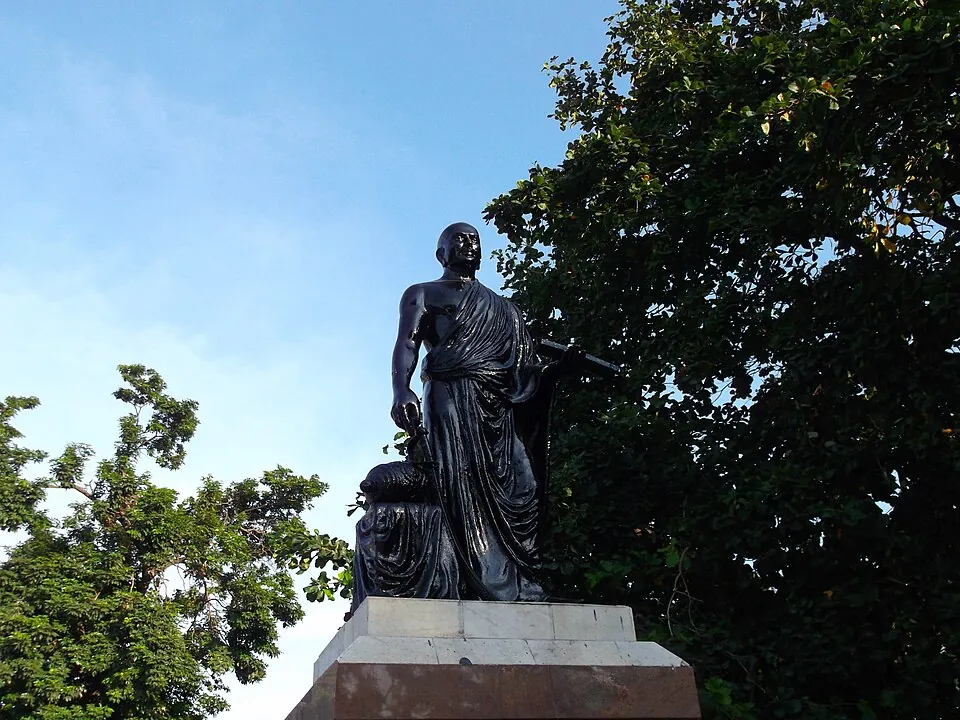
Ilango Adigal and the Song of the Anklet
Iḷaṅkō Aṭikaḷ · इलंगो अडिगल
Ilango Adigal, a Jain monk of the Chera royal family, is traditionally credited with the Tamil epic Cilappatikaram, the Song of the Anklet, ranked among the five great Tamil epics. Scholars place him in about the fourth to sixth century CE, later than the king whose story he tells.
Ilango Adigal, whose title means prince ascetic, was a Jain monk from the Chera royal family and the city of Vanci in southern India. Tradition names him as author of the Cilappatikaram, or Song of the Anklet, counted among the five great Tamil epics. In the prologue, called the patikam, he calls himself the brother of the Chera king Cenguttuvan, who belongs to the late second century. Most scholars assume instead that the poet lived much later and composed the epic from a reliable tradition about Cenguttuvan and about Kannagi, the central figure of the story, a woman who seeks justice after her husband is unjustly executed. The usual estimate puts the poet between the fourth and sixth centuries, so the date used here is an approximate midpoint rather than a precise year. The epic mixes poetry, song and prose and is celebrated for its portrait of Tamil cities, music and dance and for its theme of virtue and fate. It also reflects the Jain outlook of its author alongside local cults, such as the worship of Kannagi as a goddess. For Tamil culture it is a foundational literary text.
Sources
- Ilango Adigal Wikipedia · CC-BY-SA-4.0
- Q3032538 Wikidata · CC0-1.0