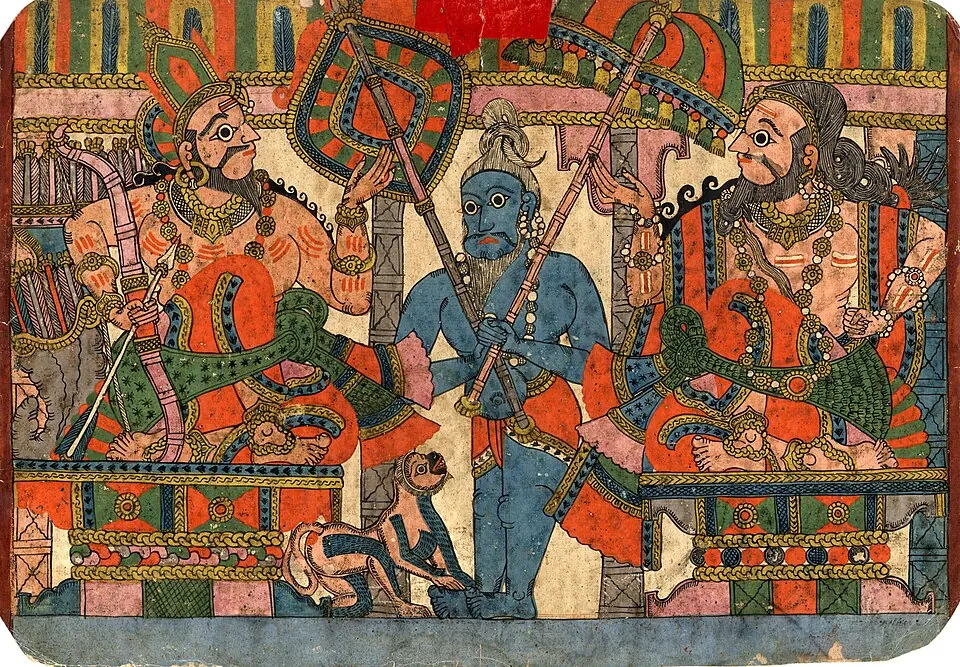
Janamejaya and the Serpent Sacrifice
Janamejaya · जनमेजय
Traditional epic chronology; Vedic king is dated by scholars to the early 1st millennium BCE.
Janamejaya was a Kuru king of the middle Vedic period who, with his father Parīkṣit, helped consolidate the Kuru state and organise Vedic hymns and śrauta rites. Later epic and Puranic tradition recalls him for the serpent sacrifice at which the Mahābhārata is first recited.
Janamejaya was a Kuru king of the Middle Vedic period. Together with his father and predecessor Parīkṣit he is credited with consolidating the Kuru state, with gathering the Vedic hymns into collections and with shaping the orthodox śrauta rituals. Their work made the Kuru realm the leading political and cultural force in northern India of that age. He also appears as a figure of later legend, in the Mahābhārata and the Purāṇas. In the epic's framing story, Janamejaya performs a great sacrifice meant to destroy the serpents, after the snake Takṣaka killed his father, and it is during this sacrifice that the sage Vaiśampāyana recites the Mahābhārata to him. The sacrifice is halted through the intervention of the sage Āstīka. The Vedic king is a historical-literary figure placed by scholars in the early first millennium BCE, while the snake sacrifice belongs to epic narrative, so the date here follows the traditional chronology and is not documented history.
Sources
- Janamejaya Wikipedia · CC-BY-SA-4.0
- Q616654 Wikidata · CC0-1.0