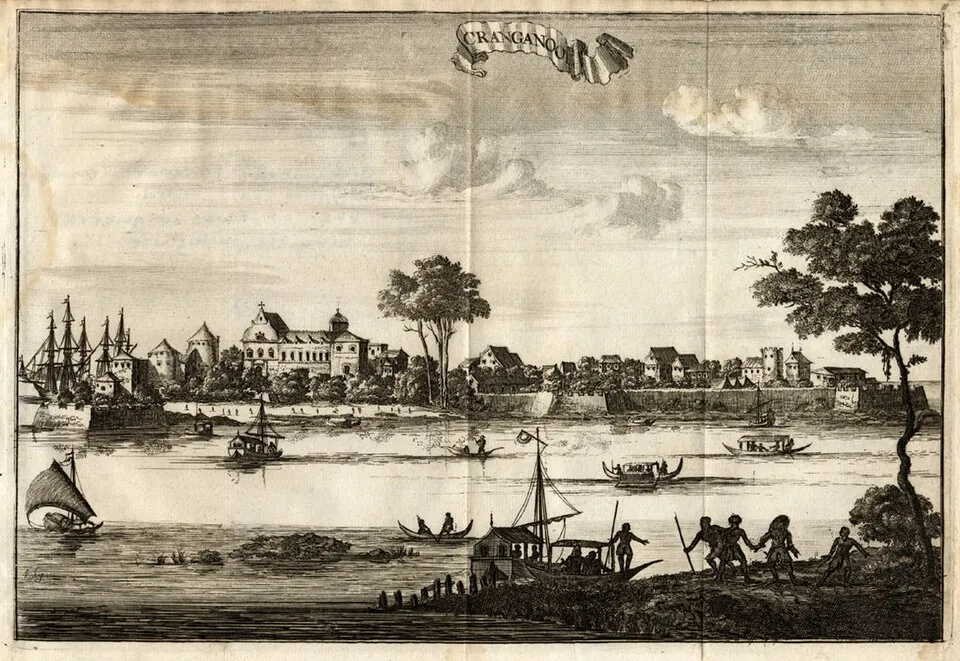
Kodungallur, Gateway of the Malabar Coast and Mahodayapuram
Koṭuṅṅallūr · कोडुंगल्लूर
Kodungallur, on the Periyar river in Kerala, was a port known in different periods as Muziris, Vanchi and Mahodayapuram. Around the ninth century it served as the capital of the Later Cheras and is remembered as an early meeting point of Hindu, Jewish, Christian, Muslim and Buddhist communities.
Kodungallur sits on the banks of the Periyar, where the Kerala lagoons begin to the north, and from ancient times its position made it a natural entry point for ships coming to the Malabar Coast. It has carried many names: Muziris or Muchiri in classical accounts, Vanchi, Shingly, Cranganore to the Portuguese, and Mahodayapuram. Under that last name it became the capital of the Later Chera kings, who ruled much of Kerala from about the ninth century until their power fell in the twelfth. The date used here is an approximate marker for that capital phase. The town is also recognised as one of the early interfaith centres of the world, linked to the arrival of Jewish, Christian and Muslim communities in India and to a Buddhist presence in the south, alongside long-standing Shaiva, Vaishnava and Shakta worship. Trade in spices and pepper drew merchants from across the Indian Ocean, and this commerce shaped local society and culture. When the Chera kingdom broke apart, smaller states such as Cochin emerged in the region. Kodungallur thus offers a compact view of how maritime trade built a plural society on India's southwestern shore.
Sources
- Kodungallur Wikipedia · CC-BY-SA-4.0
- Q1006282 Wikidata · CC0-1.0