The Pāṇḍya Dynasty of Madurai
Pāṇḍya · पाण्ड्य
The Pāṇḍyas of Madurai were one of the three great kingdoms of ancient Tamilakam with the Cholas and Cheras, attested by the 5th to 3rd centuries BCE at the latest. They rose to imperial power twice, between the 6th and 10th centuries CE and again from the 13th century, in one of South Asia's longest-lived dynasties.
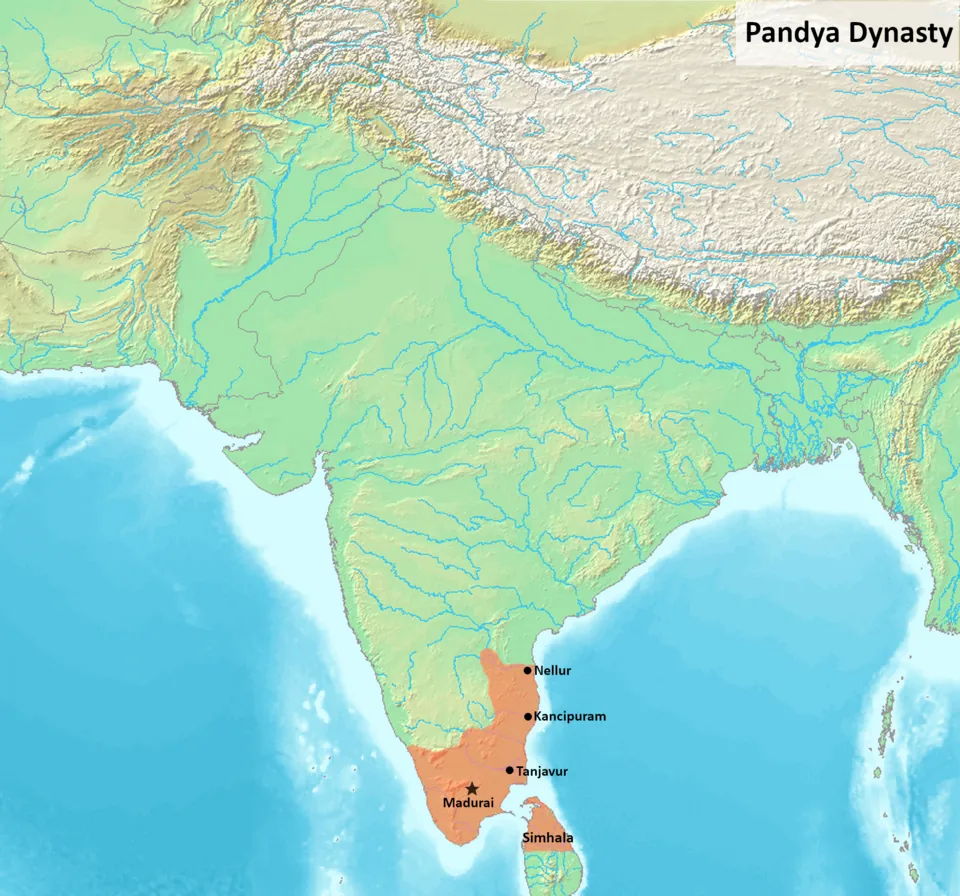
The Pāṇḍyas are an ancient Tamil dynasty, usually called the Pandyas of Madurai, and one of the three great crowned kingdoms of Tamilakam alongside the Cholas and Cheras. Evidence shows that they existed by the fifth to third centuries BCE at the latest, and they are mentioned in early Tamil poetry and in foreign accounts of Indian trade. Their history is marked by two periods of imperial dominance. The first lasted from about the sixth to the tenth century CE, and the second came under the Later Pāṇḍyas in the thirteenth and fourteenth centuries. In the second half of the thirteenth century, under Jaṭāvarman Sundara Pāṇḍya I and Māravarman Kulaśekhara Pāṇḍya I, their realm included much of southern India and parts of northern Sri Lanka through vassal states answerable to Madurai. The dynasty is regarded as one of the longest-lasting in the history of South Asia. The date used here is an approximate marker for the earliest period in which the dynasty is attested, since precise origins are not known.
Sources
- Pandya dynasty Wikipedia · CC-BY-SA-4.0
- Q844910 Wikidata · CC0-1.0