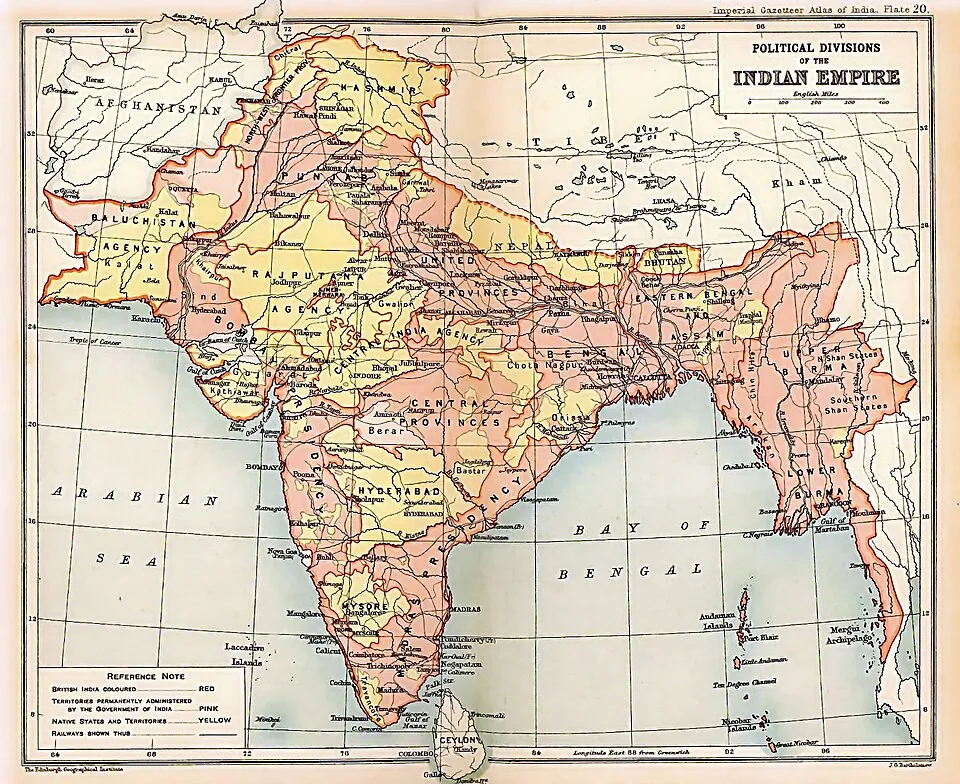
Princely States Under British Paramountcy
Deśī Riyāsat · देशी रियासत
Princely states were nominally sovereign territories of British India ruled by Indian princes under indirect rule, bound by subsidiary alliances and British paramountcy. Rulers governed internally but could not conduct foreign relations or fight one another. At independence in 1947, 565 such states were recognised, and the date shown marks the period's beginnings.
A princely state, also called a native state, was a nominally sovereign entity within the British Indian Empire that an Indian ruler governed under indirect rule, rather than the colonial government doing so directly. Each was tied to the East India Company, and later the Crown, through subsidiary alliances and the doctrine of paramountcy. Rulers were broadly free to manage their own territories, yet they could not conduct relations with outside states or wage war on each other, and the British pressed them increasingly to modernise. In 1920 the Indian National Congress asked the princes to introduce responsible government, and in 1929 Jawaharlal Nehru argued that only the peoples of these states could decide their future. Congress won most provinces in 1937, but the states held no elections. At the time of British withdrawal, 565 princely states were officially recognised, besides thousands of smaller estates. The start year is approximate, linked to the consolidation of Company power after Plassey.
Sources
- Princely state Wikipedia · CC-BY-SA-4.0
- Q1336152 Wikidata · CC0-1.0