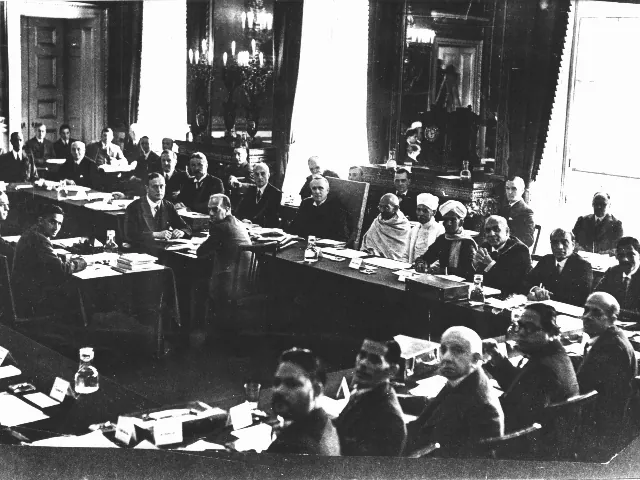
The Round Table Conferences Debate Indian Self-Rule
The three Round Table Conferences, held in London between November 1930 and December 1932, brought British politicians and Indian leaders together to discuss constitutional reform. They followed the Simon Commission report amid growing demands for swaraj and exposed deep disagreements.
The Round Table Conferences were a sequence of three meetings organised by the British government with Indian political figures to discuss constitutional change in India. They ran from November 1930 to December 1932 and followed the Simon Commission report of May 1930, acting on advice that Muhammad Ali Jinnah gave to the viceroy, Lord Irwin, and the prime minister, Ramsay MacDonald. Demands for swaraj, or self-rule, were by then growing steadily stronger. Indian participants included B. R. Ambedkar, Jinnah, Tej Bahadur Sapru, V. S. Srinivasa Sastri, Zafrulla Khan, Mirabehn and K. T. Paul. By the 1930s many British politicians believed India needed to move toward dominion status, but the Indian and British parties disagreed sharply on the details, and the talks did not produce a settlement acceptable to all sides. The conferences are best remembered for debates on separate electorates and for the presence of Ambedkar, who pressed the claims of the depressed classes, an argument that later led to the Poona Pact. They also fed into the Government of India Act of 1935, which reshaped provincial government.
Sources
- Round Table Conferences (India) Wikipedia · CC-BY-SA-4.0
- Q2735594 Wikidata · CC0-1.0