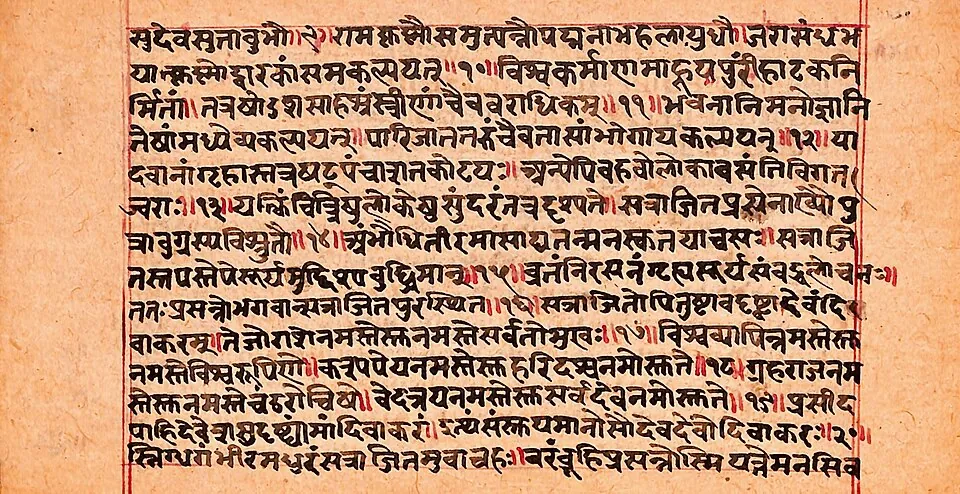
The Skanda Purana, Largest of the Mahapuranas
Skandapurāṇa · स्कन्दपुराण
The Skanda Purana, a vast Śaiva text of over 81,000 verses, is the largest of the eighteen Mahapuranas. A work by this name probably existed by the eighth century, but the surviving versions are many and have been repeatedly revised.
The Skanda Purana is the longest of the eighteen major Puranas and belongs to the Śaiva literature of Hinduism. It is named after Skanda, the son of Śiva and Pārvatī known in Tamil lands as Murugan, although he is no more prominent in it than in other Śiva-centred Puranas. A text of this title probably existed by the eighth century, which explains the placement of this entry, yet the text that survives is not one fixed book. It exists in numerous recensions that were edited and expanded across many centuries, so scholars describe it as a living, changing work rather than a single composition. The contents are encyclopaedic: they take in cosmogony, mythology, genealogy, law and duty, festivals, gemmology, temples and geography, as well as reflection on virtue, vice and the nature of Śiva as the ultimate reality. Large sections serve as guides for pilgrims, the tirtha-mahatmyas, which list sacred places across India, Nepal and Tibet and attach legends, hymns and parables to each. In common with other Puranas it is attributed to the sage Vyāsa. Historians use it as evidence for the development of ritual and pilgrimage.
Sources
- Skanda Purana Wikipedia · CC-BY-SA-4.0
- Q2497735 Wikidata · CC0-1.0