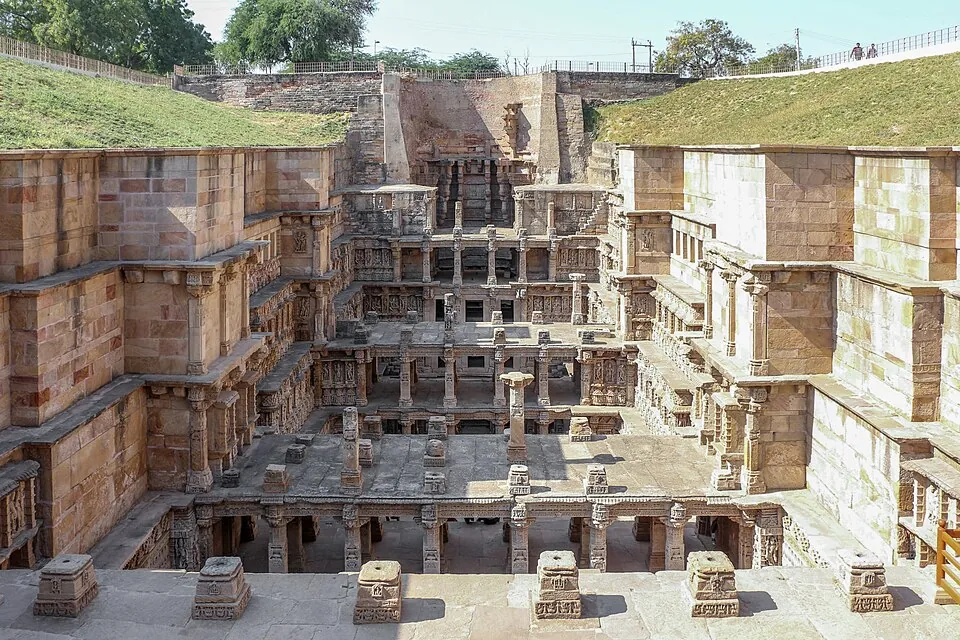
Rani ki Vav Stepwell at Patan
Rāṇī kī Vāv · रानी की वाव
Rani ki Vav, the Queen's Stepwell at Patan in Gujarat, was built in the late eleventh century and is credited to Udayamati, wife of the Chaulukya king Bhīma I. Designed as an inverted temple, its seven levels carry hundreds of sculptures. It became a UNESCO World Heritage Site in 2014.
At Patan, on the bank of the Sarasvatī river, the Chaulukya or Solanki rulers of Gujarat left behind one of India's most elaborate water monuments. Tradition credits its construction to Queen Udayamati, widow or consort of Bhīma I, who ruled in the eleventh century, and she is said to have come from the Junagadh region. The stepwell is planned as an underground temple in reverse, honouring the sanctity of water through architecture. Its stairways descend through seven levels, and every level carries panels of sculpture. In total there are more than five hundred principal figures and over a thousand smaller ones, which mix images of Hindu deities with secular and symbolic scenes. In later centuries the structure silted up and lay buried, until it was rediscovered in the 1940s. The Archaeological Survey of India carried out a major restoration in the 1980s, and in 2014 the monument was inscribed on the UNESCO World Heritage list. The year used here is approximate, since the sources place the work in the reign of Bhīma I rather than at one exact moment.
Sources
- Rani ki Vav Wikipedia · CC-BY-SA-4.0
- Q7293002 Wikidata · CC0-1.0