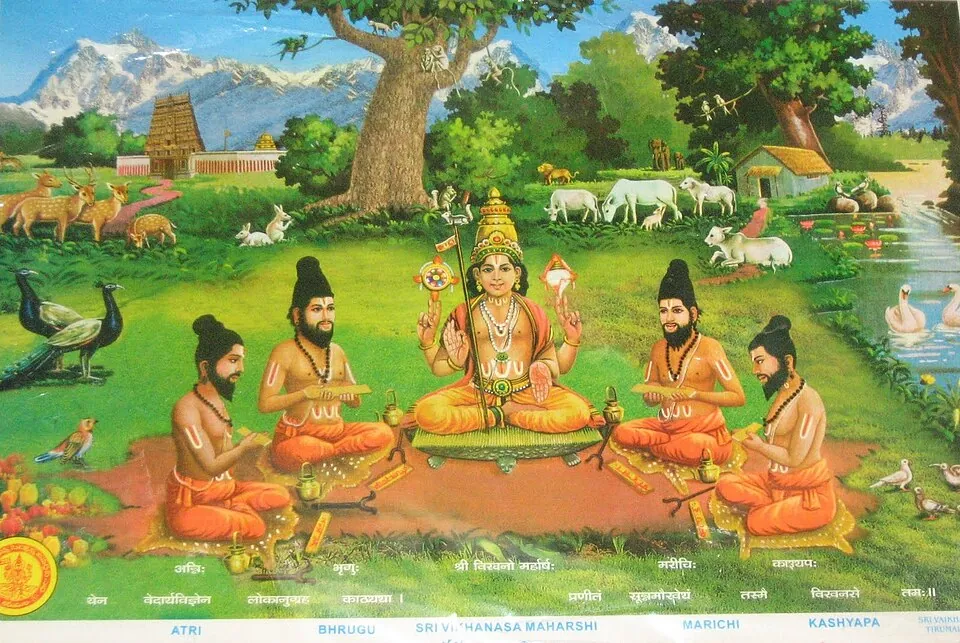
The Vaikhānasa Tradition of Viṣṇu Worship
Vaikhānasa · वैखानस
Vaikhānasa is a Vaiṣṇava Āgama tradition, named for its founder, the sage Vikhanas, which worships Viṣṇu as Supreme God and governs temple ritual. Its followers are mainly Brahmins of the Kṛṣṇa Yajurveda Taittirīya school, and it is well established in south India alongside the Pāñcarātra.
Vaikhānasa, or Vaikhānasāgama, is a tradition within Hinduism that worships Viṣṇu and his avatars as the Supreme God. Its name comes from the sage Vikhanas, regarded as its founder. It is classed as a Vaiṣṇava Āgama, meaning that it supplies rules for practices such as temple worship and ritual. Its adherents are chiefly Brahmins belonging to the Taittirīya branch of the Kṛṣṇa Yajurveda and following the Vaikhānasa Kalpasūtra. Its philosophy is broadly monotheistic, though it also contains ideas that can be described as panentheistic. Like the Pāñcarātra tradition, it has long been established in south India, where its priests continue to perform temple services. Because the tradition grew over many centuries from older sūtra literature, no single founding date is known; the year given here is an approximate marker for the period when its temple-ritual texts were taking settled form in the south.
Sources
- Vaikhanasa Wikipedia · CC-BY-SA-4.0
- Q7908734 Wikidata · CC0-1.0