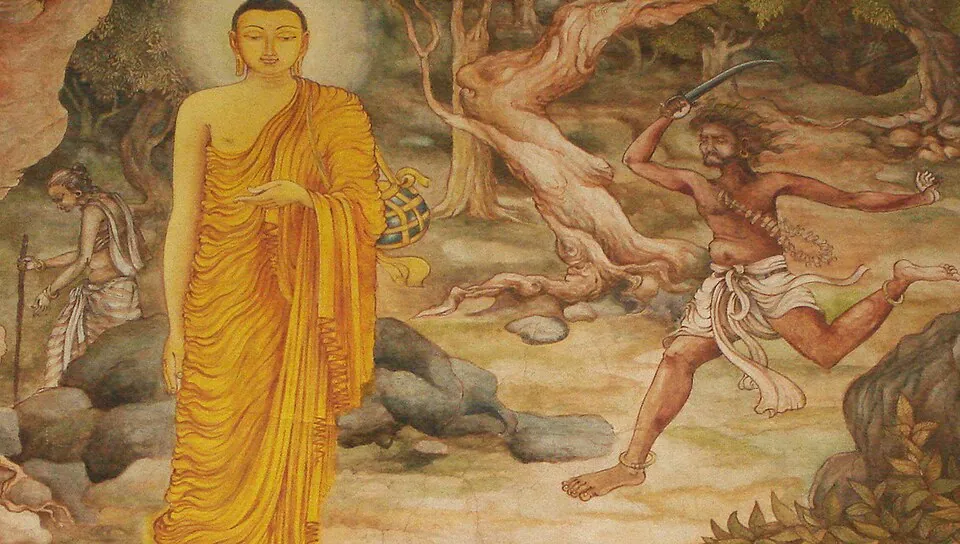
Aṅgulimāla, the Brigand Who Became a Monk
Aṅgulimāla · अङ्गुलिमाल
Placed in the Buddha's lifetime by tradition; a canonical story, not dated history.
In Buddhist tradition Aṅgulimāla, whose name means finger necklace, was a feared brigand who was converted by the Buddha and became a monk. His story, told in Pāli, Sanskrit, Tibetan and Chinese sources, is a classic case of how the Buddha's teaching can redeem even a murderer.
Aṅgulimāla, Pāli for finger necklace, is a major figure in Buddhism, especially in the Theravāda tradition. The tradition depicts him as a ruthless brigand who is wholly transformed after conversion, and Buddhists see him as the supreme example of how the Buddha's teaching can redeem a person and of the Buddha's skill as a teacher. His story appears in many sources in Pāli, Sanskrit, Tibetan and Chinese. In the account he is born Ahiṃsaka and grows into a bright young man in Sāvatthī, becoming his teacher's favourite pupil. Jealous fellow students turn the teacher against him, and the teacher sends him to collect a thousand human fingers. Aṅgulimāla becomes a murderer who makes entire villages flee, until King Pasenadi sends an army to capture him. The Buddha intervenes, wins him over, and he becomes a monk. Buddhists in South and Southeast Asia also regard him as a patron of childbirth and fertility. This is a sacred narrative, not a datable event, and the date is a loose placeholder tied to the Buddha's lifetime.
Sources
- Aṅgulimāla Wikipedia · CC-BY-SA-4.0
- Q263512 Wikidata · CC0-1.0