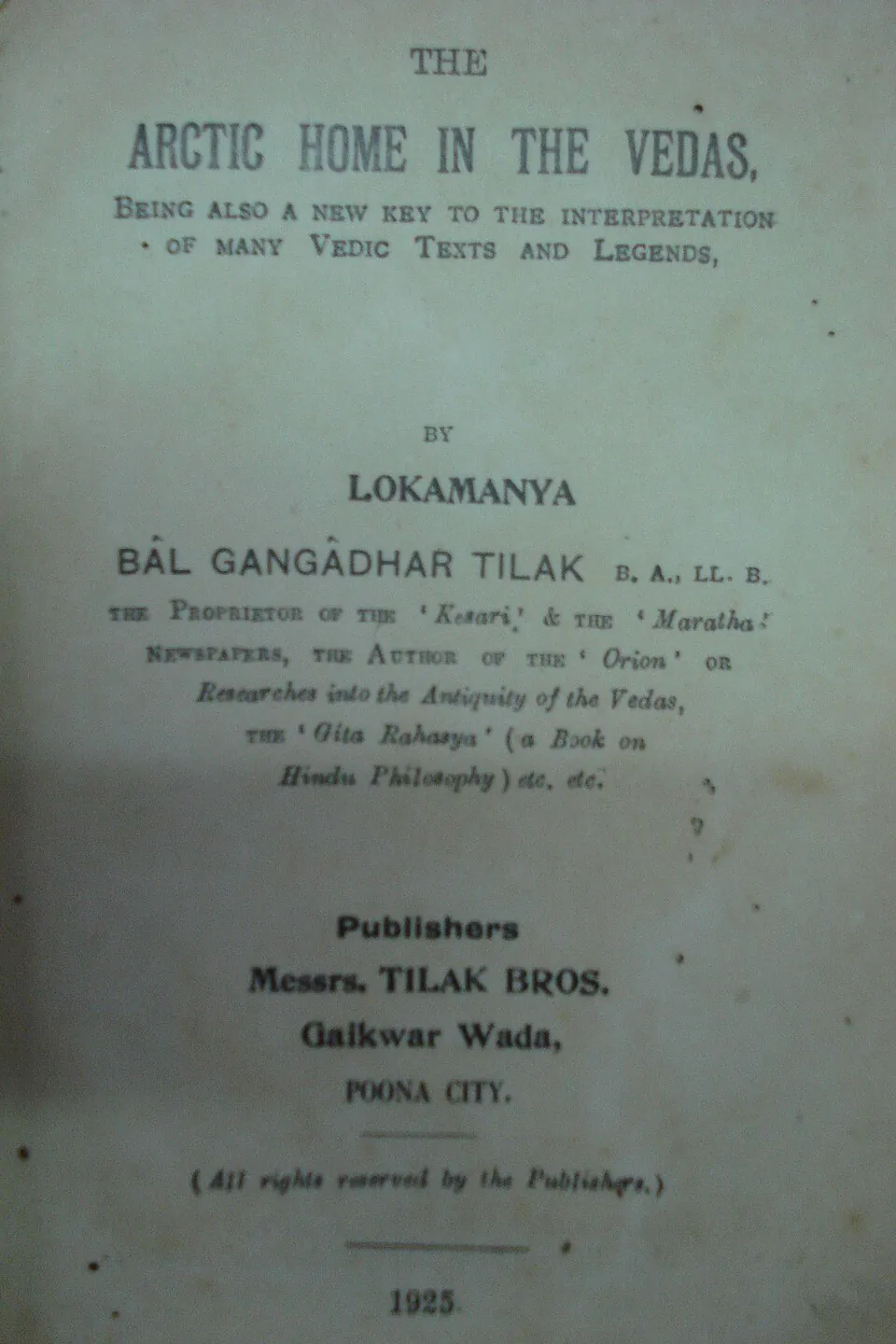
Tilak Publishes The Arctic Home in the Vedas
Bal Gangadhar Tilak's 1903 book argued from Vedic hymns, Avestan passages and calendars that the Aryans' original home lay at the North Pole, which they left around 8000 BCE. Its premises are now regarded as pseudoscientific, though it reflects a major nationalist thinker's engagement with Vedic chronology.
Bal Gangadhar Tilak, an Indian nationalist, teacher and independence activist, published The Arctic Home in the Vedas in 1903, on the question of where the Aryans came from. Reading Vedic hymns, passages in the Avesta, and Vedic systems of chronology and calendar, Tilak held that the North Pole had been the original home of the Aryans during a pre-glacial period, and that they left it because of climate change around 8000 BCE, moving into northern Europe and Asia. Present scholarship considers the book's ideas pseudoscientific, mostly because they rely on outdated notions of continental upheaval and climate history. They are also at odds with the fringe Out of India theory, since they point to a migratory origin for the Indo-Aryan peoples. Even so, current thinking holds that eastern hunter-gatherers from the taiga supplied an important share of Indo-Aryan ancestry, and that these peoples later moved into the Indian subcontinent. The work is best read as a historical document of early twentieth-century debate on Aryan origins.
Sources
- The Arctic Home in the Vedas Wikipedia · CC-BY-SA-4.0
- Q4069479 Wikidata · CC0-1.0