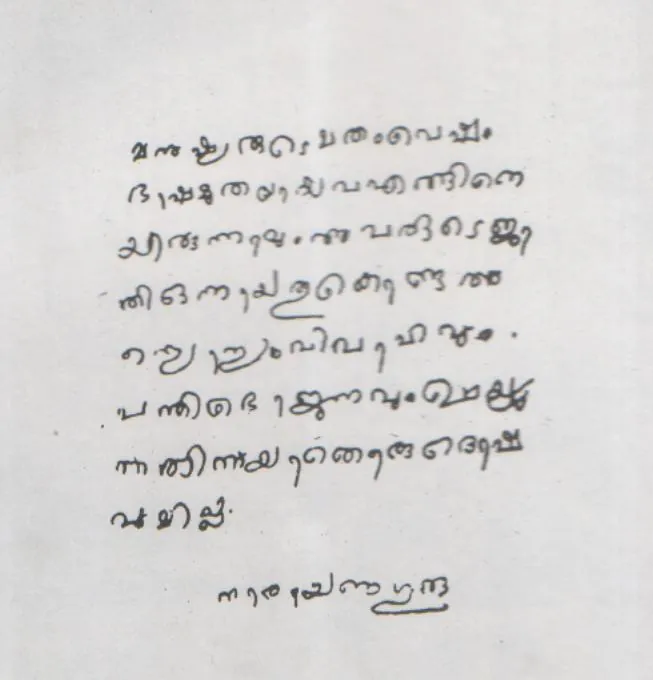
Narayana Guru's Ātmopadeśa Śatakam in Malayalam
Ātmopadeśa Śatakam · आत्मोपदेश शतकम्
'Believed to have reached its present form by 1897'; the exact year of composition is not fixed.
Ātmopadeśa Śatakam, a hundred-verse Malayalam poem by the Kerala reformer Narayana Guru, is thought to have reached its final shape by 1897. It sets out, as self-instruction, a path to self-realisation centred on the Self or Atman rather than on devotion to any god.
Ātmopadeśa Śatakam, a title that can be rendered as a hundred verses instructing the self, is a Malayalam poem by Narayana Guru, the social reformer and spiritual leader of Kerala. It is regarded as his classic work. Each of its hundred verses describes actions that the self performs upon itself, marking moments of transformation toward an absolute value. It was first issued as Atmabodham, and it is thought to have taken its final shape around 1897. It was presented before a gathering at Aruvippuram as practical advice for his followers. Narayana Guru also composed in Sanskrit and Tamil, yet he chose Malayalam for this one. Many of his earlier compositions praised Hindu deities against an underlying Advaita Vedanta background, but here he describes directly how to attain self-realisation and urges seeking the absolute value called the Self, or Atman, rather than a god to adore. His chief disciple Nataraja Guru rendered it into English as Centiloquy of the Self, and Nitya Chaitanya Yati wrote a commentary on it.
Sources
- Atmopadesa Śatakam Wikipedia · CC-BY-SA-4.0
- Q17001370 Wikidata · CC0-1.0