Aurangzeb's Bādshāhī Mosque Rises in Lahore
Bādshāhī Masjid · بادشاہی مسجد
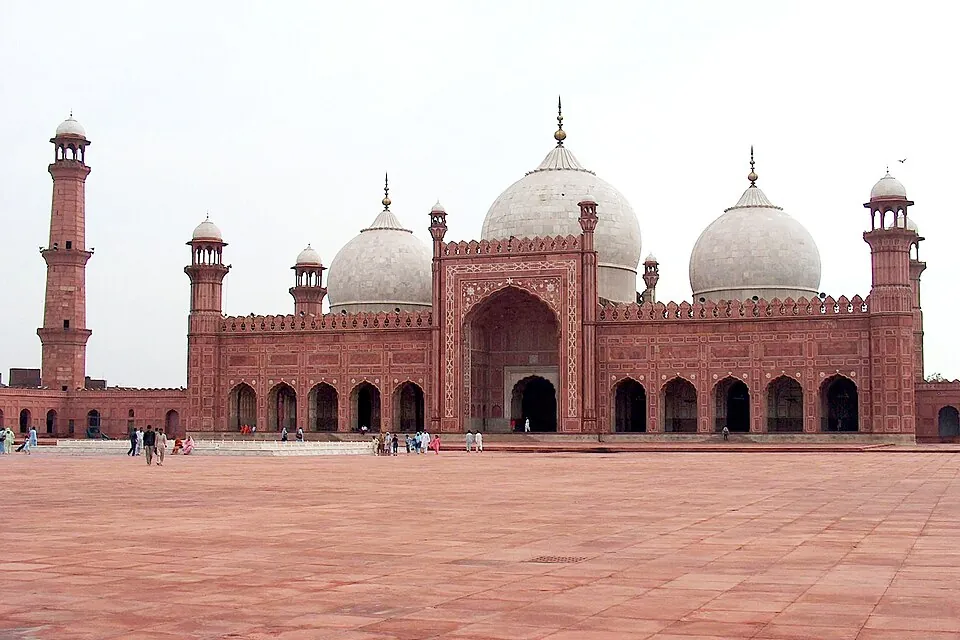
The Bādshāhī Mosque of Lahore, built between 1671 and 1673 by Aurangzeb opposite the Lahore Fort, is among the great Mughal monuments. Faced in red sandstone and white marble, it was the biggest mosque of the Mughal age and remains an icon of Pakistan.
The Bādshāhī, or Imperial, Mosque stands in Lahore, in Punjab, Pakistan, facing the Lahore Fort across an open ground at the northern edge of the old Walled City. The Mughal emperor Aurangzeb had it built between 1671 and 1673. It is a major example of Mughal architecture, with a façade of red sandstone, carved and set off by white marble inlay, a vast courtyard that can hold tens of thousands of worshippers, and a prayer hall crowned by three marble domes and flanked by tall minarets. No larger mosque was raised in the entire Mughal era, and it held that distinction for many years afterwards. The mosque was supervised by the governor of Lahore, Fidāʾī Khān Kokā, and it formed part of a larger Mughal vision of the city as an imperial capital. During the Sikh period it was put to other uses, including as a garrison, and later restoration returned it to worship. Today it is regarded as one of the best-known landmarks of the country and draws large numbers of visitors alongside the nearby fort and the tomb of the poet Muḥammad Iqbāl. Its scale and decoration make it a monument of Mughal power and faith.
Sources
- Badshahi Mosque Wikipedia · CC-BY-SA-4.0
- Q330872 Wikidata · CC0-1.0