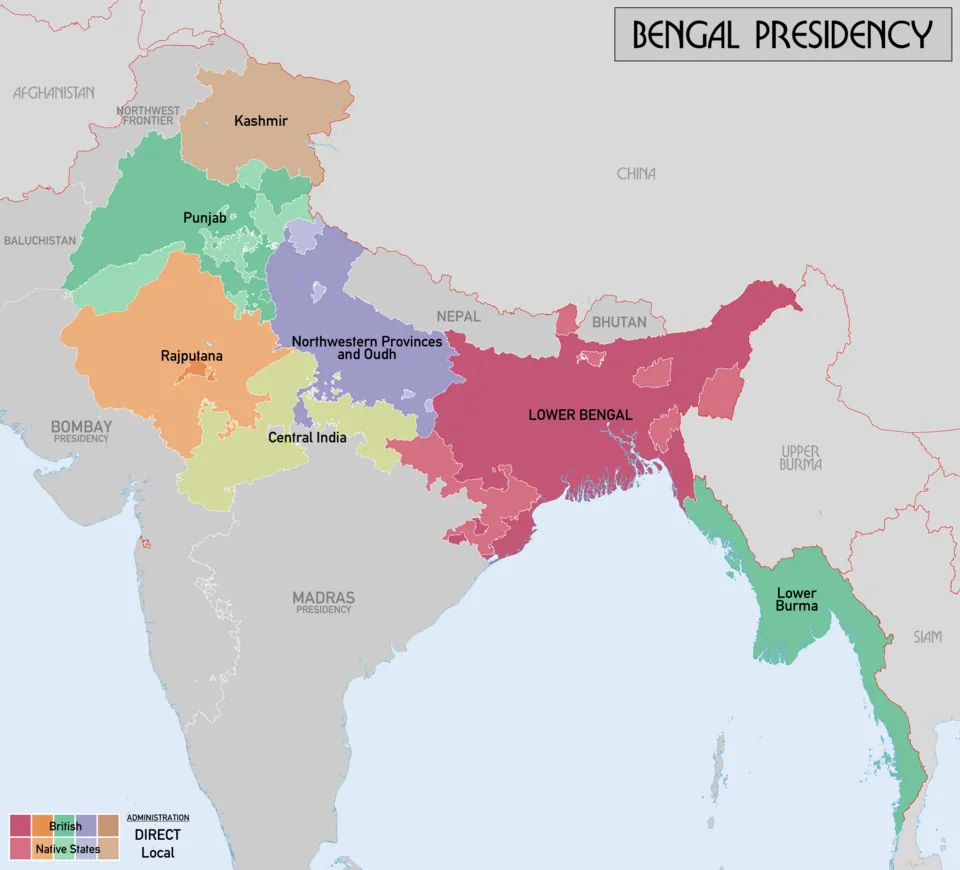
Bengal Presidency Grows from Plassey to Fort William
The Bengal Presidency, formally the Presidency of Fort William, became the largest of British India's three presidencies. Rooted in Company trading posts from 1612, it expanded after victories over Bengal's nawab in 1757 and 1764, and Calcutta served as India's capital until 1911.
The Presidency of Fort William in Bengal, later styled the Bengal Province, was the largest administrative unit of British India under Company rule and then the Crown. It grew out of trading stations set up in the Mughal province of Bengal from 1612, in Jahāngīr's reign, by the East India Company. The Company competed with other European firms for influence there, and in 1757 and 1764 it defeated the nawab of Bengal, who acted under Mughal authority. Those wins opened the way to political control. At its widest, the presidency's jurisdiction covered much of South Asia and reached into Southeast Asia. Calcutta, which had grown around Fort William, was its capital, and the governor of Bengal also served as governor-general of India, so the city was the imperial capital until 1911. Core Bengal covered what is now Bangladesh, West Bengal and Tripura. The presidency shaped colonial administration, law and education, and its history is bound closely to the Bengal Renaissance.
Sources
- Bengal Presidency Wikipedia · CC-BY-SA-4.0
- Q817165 Wikidata · CC0-1.0