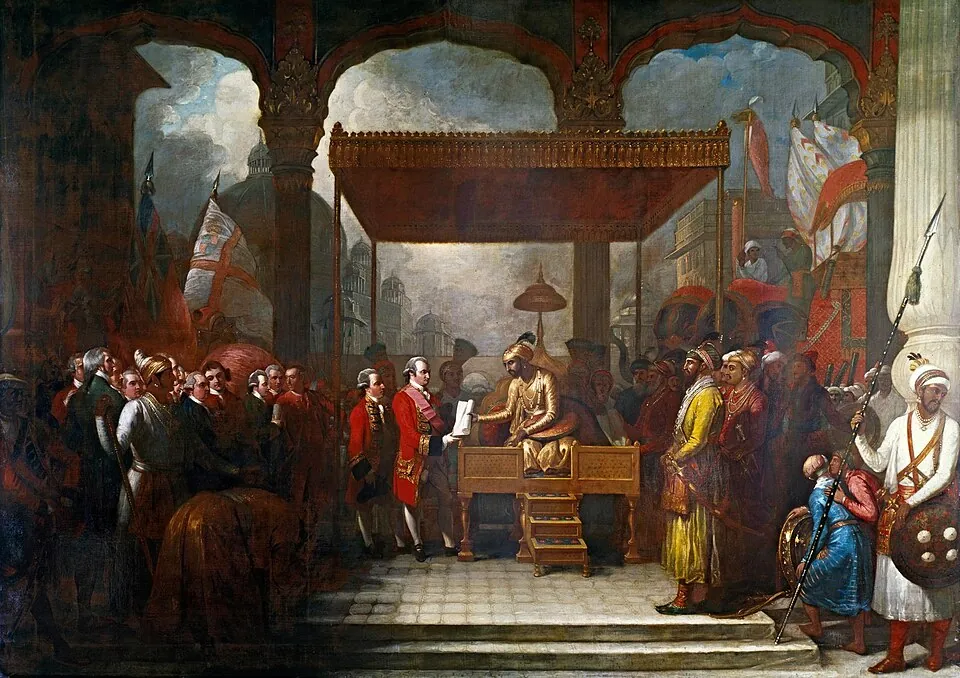
Treaty of Allahabad Hands Bengal's Revenues to the Company
Signed on 16 August 1765 by Emperor Shah Alam II and Robert Clive, the Treaty of Allahabad followed the Battle of Buxar. It granted the East India Company the diwani, the right to collect revenue in Bengal, Bihar and Orissa, and marked the start of British constitutional involvement in India.
After the Battle of Buxar in October 1764, the Mughal emperor Shah Alam II came to terms with Robert Clive of the East India Company at Allahabad. The agreement was dated 16 August 1765 and the text was copied out by hand by I'tisam-ud-Din, a Bengali scribe and envoy of the Mughal court. Its central clause gave the Company the diwani of Bengal, Bihar and Orissa, meaning the authority to collect land revenue in those provinces in the emperor's name. In return the Company undertook to pay the emperor a yearly sum and to leave him in possession of Allahabad and the surrounding district. Because revenue was the foundation of government, this transfer gave a trading corporation direct fiscal control over a vast and wealthy population, while the formal sovereignty of the Mughal throne continued on paper. Historians see the treaty as the moment when British involvement in India became political and constitutional rather than merely commercial. It created the financial base from which the Company later expanded its armies and its territory across the subcontinent.
Sources
- Treaty of Allahabad Wikipedia · CC-BY-SA-4.0
- Q4062556 Wikidata · CC0-1.0