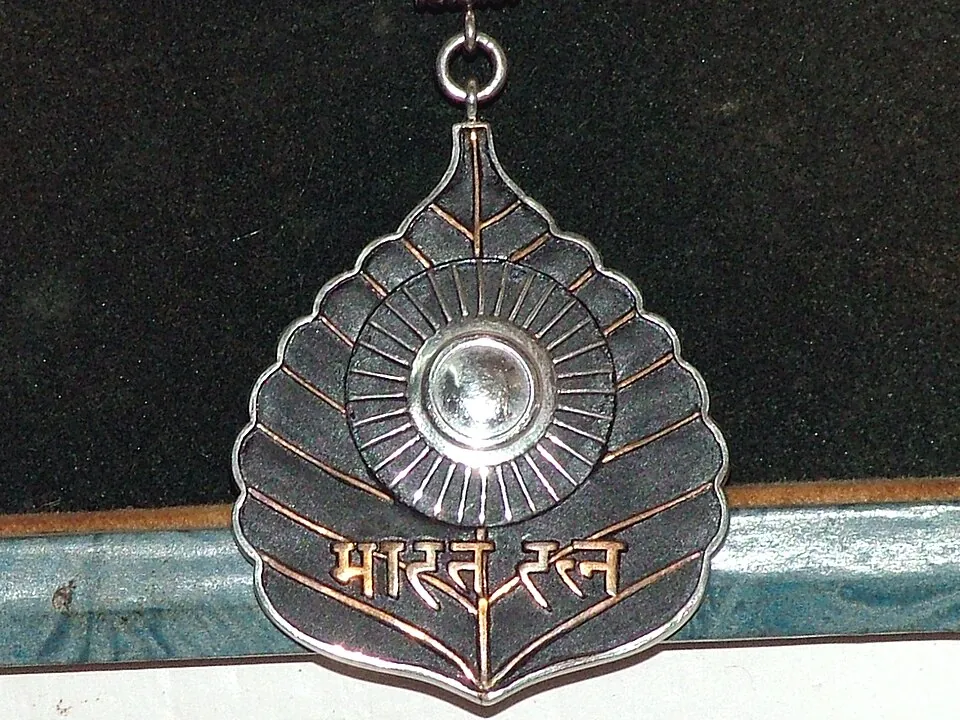
Bharat Ratna Instituted as India's Highest Honour
Bhārata Ratna · भारत रत्न
The Bharat Ratna, meaning Jewel of India, was instituted on 2 January 1954 as the Republic of India's foremost civilian honour. The first recipients that year were C. Rajagopalachari, Sarvepalli Radhakrishnan and C. V. Raman. Since December 2011 it can recognise service in any field of human endeavour.
The Bharat Ratna is the top civilian honour that the Republic of India confers. It was instituted on 2 January 1954 to honour exceptional service or performance of the highest order, without regard to race, occupation, position or gender. At first the award was confined to achievements in art, literature, science and public service, but in December 2011 the government widened the criteria to cover any field of human endeavour. Recipients are given a certificate, called a sanad, signed by the president, and a medallion shaped like a leaf of the sacred fig. Holders are placed seventh in the official order of precedence. The first three recipients, honoured in 1954, were C. Rajagopalachari, who had been governor-general, Sarvepalli Radhakrishnan, who had served as vice-president, and the physicist C. V. Raman. Over the following decades the award has gone to scientists, statesmen, artists, musicians and social workers, and decisions on individual names have sometimes been debated in public.
Sources
- Bharat Ratna Wikipedia · CC-BY-SA-4.0
- Q322132 Wikidata · CC0-1.0