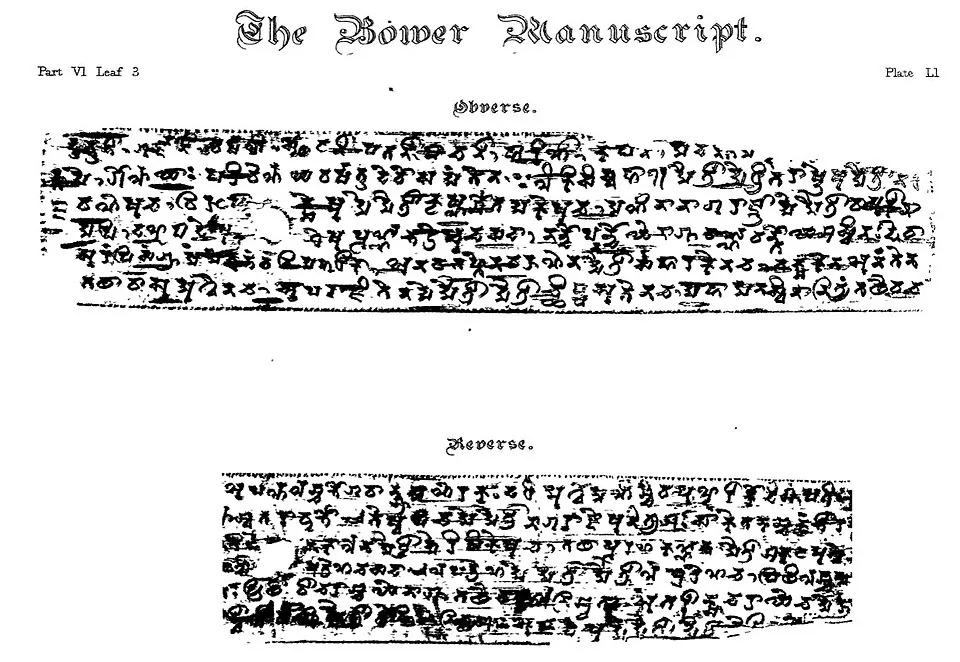
Bower Manuscript, Early Indian Medicine on Birch Bark
Bower Manuscript · बोवर पाण्डुलिपि
The Bower Manuscript is a group of seven fragmentary Sanskrit treatises on birch bark, found in a stupa near Kucha in north-western China and dated to the fifth or early sixth century. It preserves the earliest dated pieces of Indian medical writing, the Navanītaka.
The Bower Manuscript comprises seven broken Sanskrit works written on birch bark in an early Gupta, or late Brāhmī, script. It lay buried inside a Buddhist stupa close to Kucha, in what is now north-western China, and is generally dated between the fifth and the early sixth century CE. Three of its texts are on Ayurvedic medicine, two give methods of divination by dice, and two are charms against snake bite. Among the medical portions is the Navanītaka, whose fragments are the earliest dated survivals of any Indian medical writing. The manuscript also contains passages from the Bheḷa Saṃhitā, a medical work otherwise known from a worn manuscript kept at Tañjāvūr in Tamil Nadu. At least four scribes seem to have copied it. Some opening invocations call on the Buddha and Buddhist deities, while others call on Śiva, Viṣṇu and Devī, so it reflects mixed religious practice. Its discovery in Central Asia is taken as evidence of the exchange of medical ideas between India, China and the oases of the Silk Road, long before more famous translations. The date here is a scholarly estimate for the manuscript itself.
Sources
- Bower Manuscript Wikipedia · CC-BY-SA-4.0
- Q4950857 Wikidata · CC0-1.0