The British Raj Begins
Brāṭiś Rāj · ब्रिटिश राज
The British Raj was the period of direct British Crown rule over the Indian subcontinent from 1858 to 1947. It followed the transfer of power from the East India Company after the 1857 rebellion and ended with the partition into India and Pakistan.
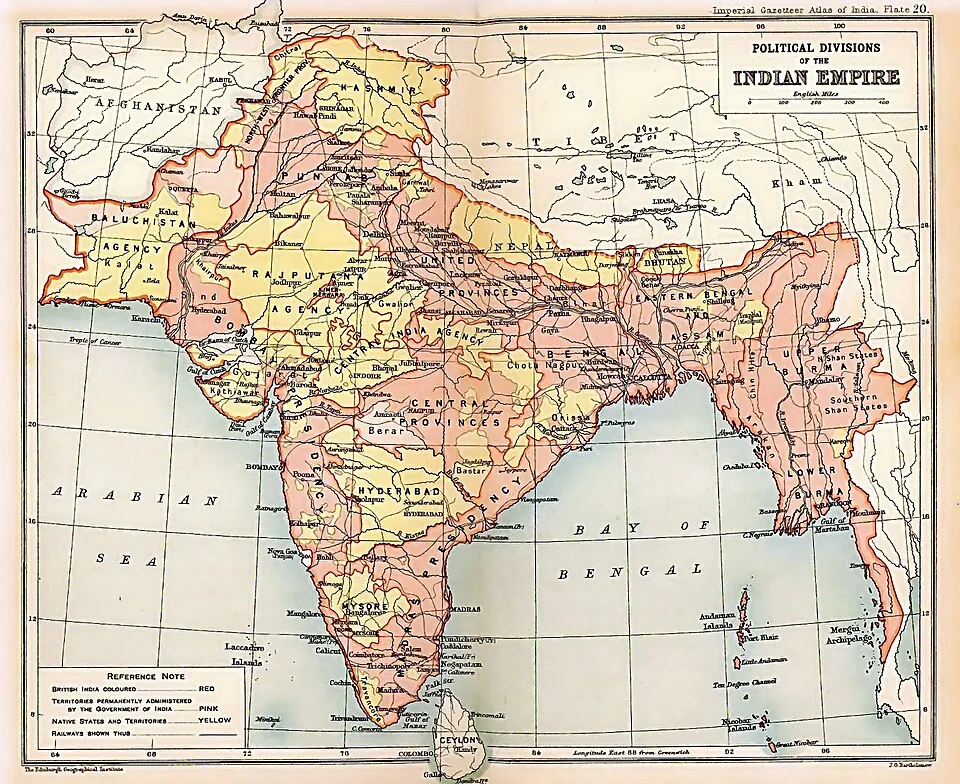
The Raj, from the Hindustani word for rule, denotes the period when the British Crown governed the subcontinent directly, between 1858 and 1947. It was established on 28 June 1858 after the Indian Rebellion of 1857, when the East India Company's authority was handed to the Crown under Queen Victoria, who took the title Empress of India in 1876. The territory included British India, the areas administered directly by the United Kingdom, and the princely states, which were ruled by indigenous kings under British paramountcy. Contemporaries usually called the whole region India, and it was sometimes styled the Indian Empire, though not officially. India belonged to the League of Nations from its start, was an original signatory at the founding of the United Nations in 1945, and took part in several Olympic Games before independence. The system ended in 1947, when the Raj was divided into two sovereign dominions, the Union of India and the Dominion of Pakistan. Historians assess the period for its administrative and economic changes, for the resistance that grew into the independence movement, and for the human cost of famines and partition.
Sources
- British Raj Wikipedia · CC-BY-SA-4.0
- Q129286 Wikidata · CC0-1.0