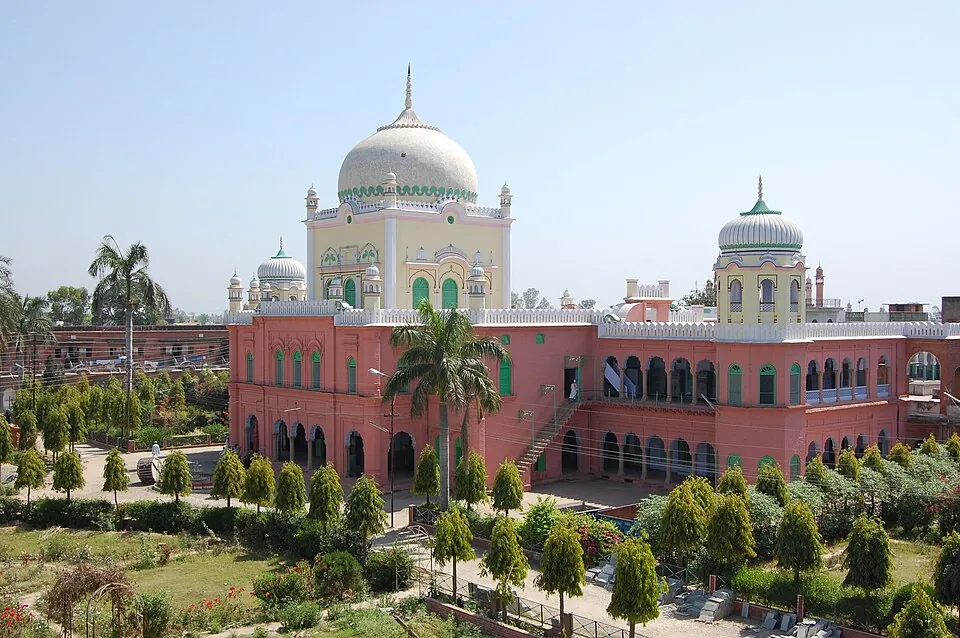
Darul Uloom Deoband Founded after 1857
Dār al-ʿUlūm Deoband · दारुल उलूम देवबंद
Darul Uloom Deoband was established on 31 May 1866 in Deoband, Uttar Pradesh, in the years after the 1857 revolt. It started in the shade of a pomegranate tree, teaching the traditional Dars-i Nizami syllabus, and grew into a leading centre of Islamic learning and the Deobandi movement.
Darul Uloom Deoband is a Muslim theological school in the town of Deoband, Uttar Pradesh, founded on 31 May 1866, which corresponds to 15 Muharram 1283 in the Islamic calendar. Its creation came in the aftermath of the 1857 revolt, when many Muslim scholars sought new ways to preserve religious learning without state patronage. Local scholars and notables, led by Sayyid Muhammad Abid, were behind the effort, and Muhammad Qasim Nanautawi is described in later historical writing as its intellectual guide and chief founder. Teaching started informally under a pomegranate tree, following the Dars-i Nizami, a long-established course of study. Funded by public donations rather than rulers, the school later grew into one of the most influential centres of Islamic learning in South Asia, second only to Al-Azhar in the wider Muslim world by some estimates. It gave rise to the Deobandi movement within Sunni Islam, which spread through a network of affiliated madrasas across the subcontinent and beyond.
Sources
- Darul Uloom Deoband Wikipedia · CC-BY-SA-4.0
- Q1165608 Wikidata · CC0-1.0