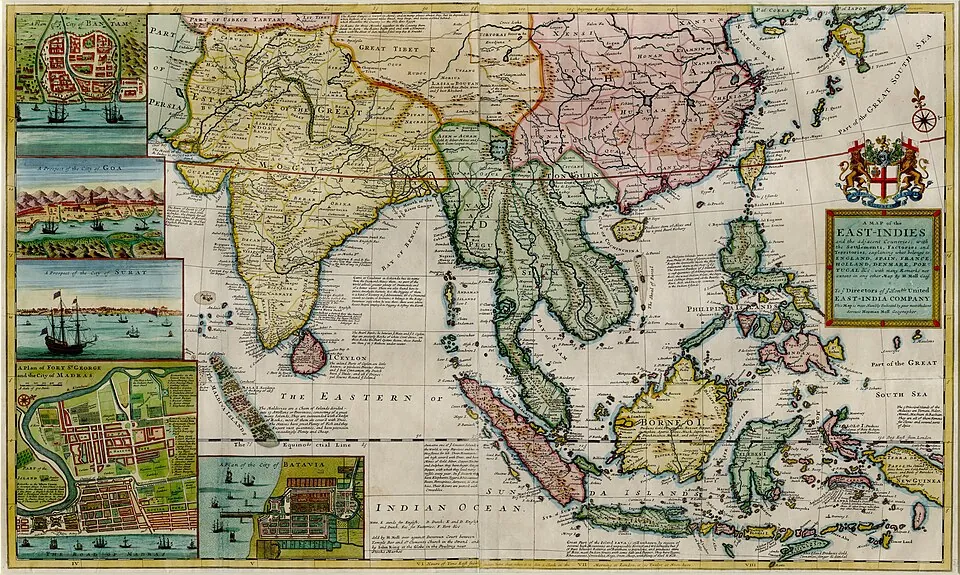
The East India Company Receives Its Royal Charter
In 1600 Queen Elizabeth I granted a charter to a London joint-stock company for trade with the East Indies. The East India Company grew from a trading body into a ruler of much of the subcontinent before its dissolution in 1874.
The East India Company began as an English, later British, joint-stock enterprise, founded in 1600 when a royal charter gave a group of London merchants the exclusive right to trade with the East Indies. The aim was to share in the spice and cotton trades that Portuguese and Dutch merchants already dominated. For its first century and more the Company operated through coastal trading posts, called factories, at places such as Surat, Madras and Bombay, with permission from Indian rulers. Its role changed after the mid-eighteenth century, when victories such as Plassey and Buxar, and the grant of the revenue rights of Bengal in 1765, turned it into a territorial power with its own armies. By the early nineteenth century it controlled large parts of the subcontinent and was among the largest corporations in the world. Parliament gradually curbed its powers through acts passed in 1773, 1784 and 1813, and after the revolt of 1857 its functions were passed to the Crown. It was finally dissolved in 1874. The year 1600 marks the start of this long transformation.
Sources
- East India Company Wikipedia · CC-BY-SA-4.0
- Q83164 Wikidata · CC0-1.0