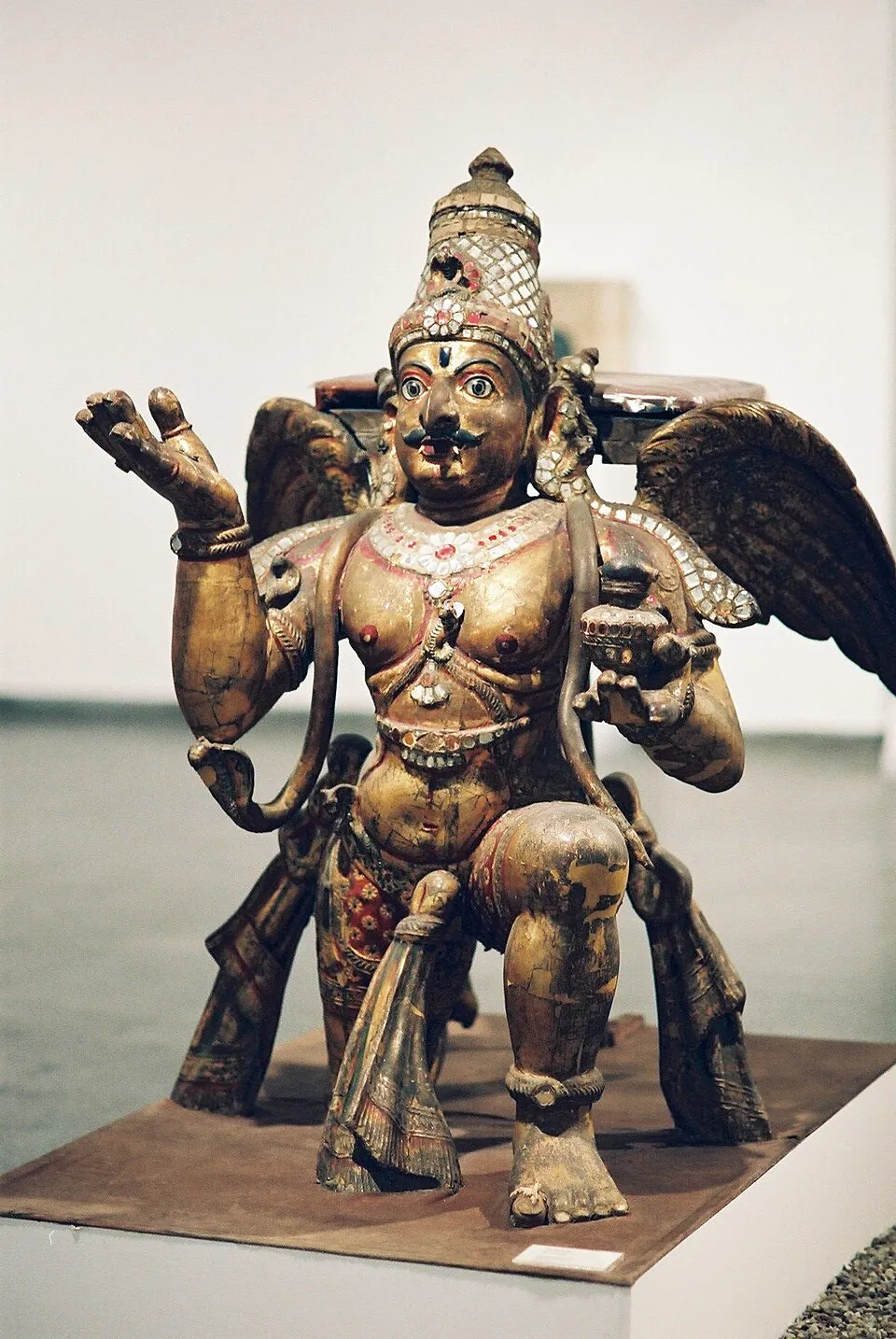
Garuḍa, Vāhana of Viṣṇu
Garuḍa · गरुड
Mythic figure of Purāṇic tradition with no dated origin; placed at the start of the cosmic era only as a conventional marker, not as history.
In Hindu tradition Garuḍa is the great bird-king who serves as Viṣṇu's mount, a protector figure also known in Buddhist and Jain lore. Texts name him as the son of the sage Kaśyapa and Vinatā. His story belongs to sacred narrative, not to dated history.
Garuḍa is a divine figure in Hindu tradition, usually shown as the vāhana, or vehicle, of Viṣṇu. He is described as the king of birds, with a kite-like form, and artists portray him either as a giant bird with half-spread wings or as a winged man with avian traits. The Purāṇas and the Mahābhārata give his parentage as the sage Kaśyapa and Vinatā, which makes him a half-brother of the gods, the nāgas and other beings, and a younger brother of Aruṇa, charioteer of the sun. He is also mentioned in Vedic literature and appears in Buddhist and Jain writings, in which he often opposes serpents. As a protector, he is credited with great strength and speed, and his image is placed in front of Vaiṣṇava temples and on flagstaffs, while his figure is used in the emblems of several Asian states. This entry places him at the opening of the cosmic cycle only as a conventional marker of the Purāṇic narrative, since the stories about Garuḍa describe mythical times with no dateable origin and no historical chronology.