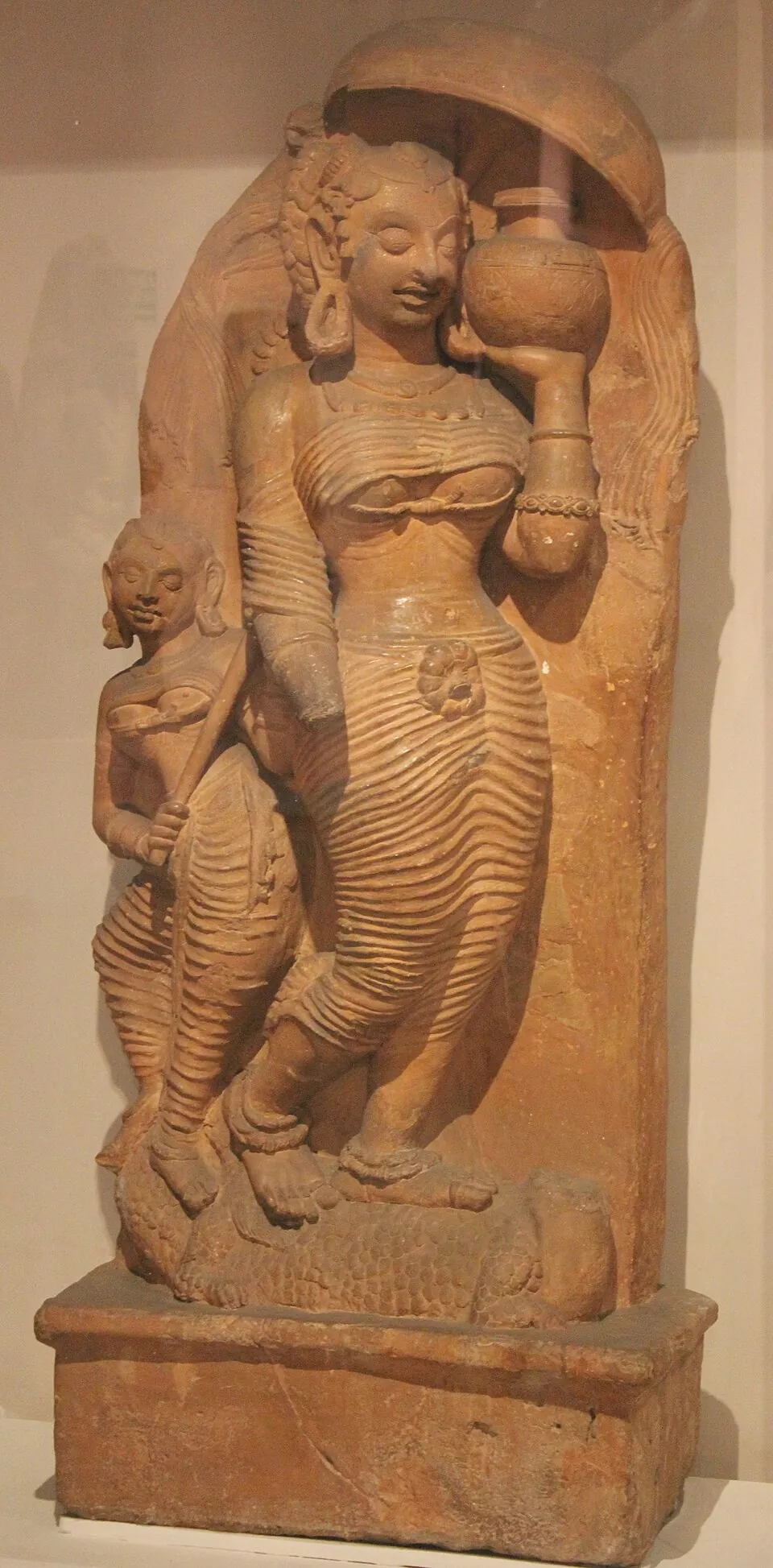
Gaṅgā, the River Personified as Goddess
Gaṅgā · गङ्गा
Traditional puranic reckoning; sacred narrative, not dated history.
Gaṅgā is the river Ganges honoured as a goddess of purification and forgiveness, usually shown riding a makara. Epic and Purāṇic tradition tells of her descent from heaven for the sage Bhagīratha, with Śiva breaking her fall, and of her motherhood of Bhīṣma. Her story is sacred narrative, not dated history.
In the Hindu devotional imagination the Ganges is a living goddess, Gaṅgā, honoured as a giver of purification and forgiveness. Artists show her as a graceful, richly adorned woman seated upon a makara, a crocodile-like creature. Her mythology took shape after the Vedic age and appears in the Rāmāyaṇa, the Mahābhārata and the Purāṇas. Most accounts say she flows from the feet of Viṣṇu, while the Rāmāyaṇa calls her the eldest daughter of Himavat, the Himalaya, and sister of Pārvatī. Her best-known tale is the descent to earth, granted to the royal sage Bhagīratha so that the ashes of his ancestors could be cleansed. Śiva received her torrent in his matted locks to soften the fall and then let her flow gently onto the plains. The Mahābhārata adds that she became the wife of King Śantanu and the mother of Bhīṣma. Devotees regard her as a mother to all, and families immerse the ashes of the dead in her waters in the hope of bringing the departed nearer to liberation. These accounts belong to sacred narrative and are not tied to a historical date.
Sources
- Ganga (goddess) Wikipedia · CC-BY-SA-4.0
- Q580113 Wikidata · CC0-1.0