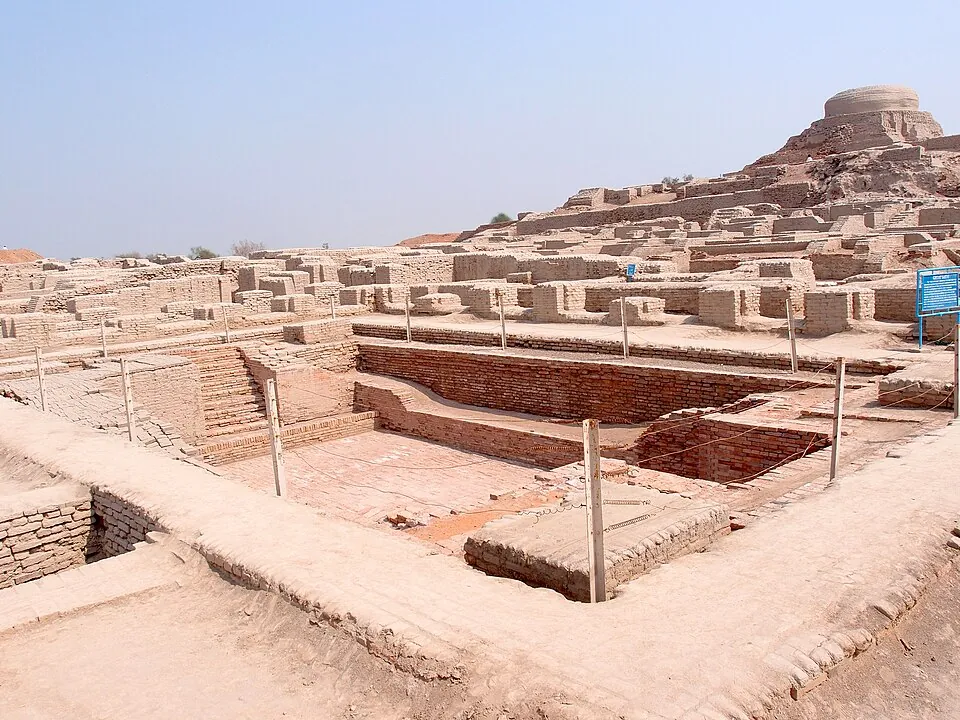
The Great Bath of Mohenjo-daro
At Mohenjo-daro in Sindh, a carefully waterproofed brick pool stands on the raised citadel mound. Excavation evidence places its building in the third millennium BCE, shortly after that platform was raised. It ranks among the most recognisable monuments of the Harappan civilisation.
The Great Bath lies on the citadel mound of Mohenjo-daro, one of the principal cities of the Harappan civilisation, in what is now Sindh, Pakistan. Archaeologists date its construction to the third millennium BCE, not long after the platform beneath it was raised. It is a large rectangular pool set in a courtyard, lined with fine brickwork and made watertight with a bitumen layer, and approached by steps. Rooms and passages surround it, and a drainage channel carries water away. Because it sits within the most prominent part of the city, scholars have often suggested a ritual purpose such as ceremonial bathing, but the Harappan script remains undeciphered and no text confirms this, so the function is an inference, not a settled fact. Whatever its use, the structure shows careful planning, advanced brick construction and a notable concern with managing water. It has become a symbol of Indus urban engineering, and it ranks among the most photographed features of the site, which is protected as a World Heritage property.
Sources
- Great Bath Wikipedia · CC-BY-SA-4.0
- Q3346415 Wikidata · CC0-1.0