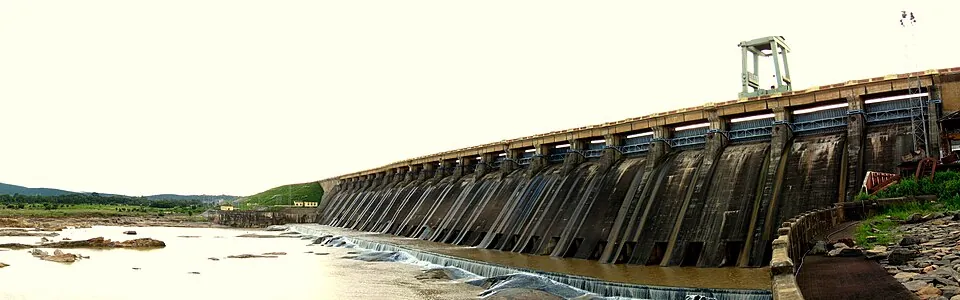
Hirakud Dam Dedicated on the Mahanadi
Hīrākuḍa · हीराकुड
Hirakud, an earthen dam on the Mahanadi near Sambalpur in Odisha, ranks with the earliest large river-valley schemes of independent India. Begun in 1946 and dedicated in 1957, it controls floods, supplies irrigation and generates power, though it displaced about twenty-two thousand people.
Hirakud Dam crosses the Mahanadi about ten kilometres from Sambalpur in Odisha. It is a composite earthen dam, among the longest of its kind in the world, and it holds back a reservoir some fifty-five kilometres long. Work began in 1946, before independence, and the scheme was among the earliest large multipurpose dam projects taken up by the new nation. Jawaharlal Nehru dedicated it in January 1957, though electricity generation and pumping had started a year earlier and the whole programme was finished only in the 1960s. The purposes were threefold: to restrain the floods that regularly afflicted the Mahanadi delta, to bring water to farmland, and to produce hydroelectricity for the region. The cost to the people of the area was high. The rising water covered a number of villages, displaced about twenty-two thousand people and drowned some two hundred temples, whose remains are of interest to researchers and divers. Siltation has since cut the reservoir's capacity by roughly a quarter. The project is often cited in debates about the benefits and human costs of large dams.
Sources
- Hirakud Dam Wikipedia · CC-BY-SA-4.0
- Q1940209 Wikidata · CC0-1.0