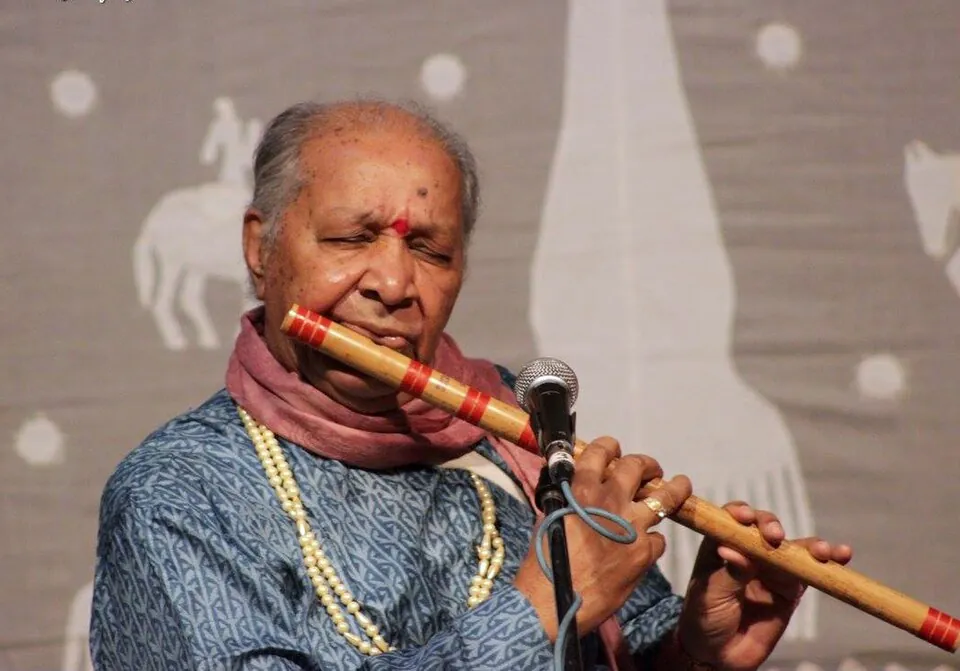
Hariprasad Chaurasia Begins at All India Radio
Hariprasād Caurasiyā · हरिप्रसाद चौरसिया
Hariprasad Chaurasia, born in 1938, started his professional career in 1957 with All India Radio at Cuttack while secretly studying music. From the late 1950s he worked to bring the bansuri to the concert stage, making him an internationally known figure in Indian classical music.
Hariprasad Chaurasia, born on 1 July 1938, grew up in a family without a professional musical background. His father wanted him to train as a wrestler, so he studied music in secret. In 1957 he began a professional career with All India Radio at Cuttack, and in 1962 he was transferred to Bombay, where he worked both in classical music and in the Hindi film industry. From the closing years of the 1950s he worked to raise the bansuri, the bamboo flute, to the concert stage, borrowing techniques from both vocal and instrumental Hindustani music. He later trained under Annapurna Devi, a teacher of the Maihar gharana. Besides his concert work he was a studio flautist and, with the santoor player Shivkumar Sharma, formed the film-composing partnership known as Shiv-Hari, whose scores include Silsila in 1981 and Chandni in 1989. He also collaborated with a wide circle of artists, from the Beatle George Harrison to the tabla player Zakir Hussain, the guitarist John McLaughlin and the saxophonist Jan Garbarek. Honours include the Sangeet Natak Akademi Award of 1984, a Padma Bhushan in 1992 and the higher Padma Vibhushan in 2000.
Sources
- Hariprasad Chaurasia Wikipedia · CC-BY-SA-4.0
- Q212512 Wikidata · CC0-1.0