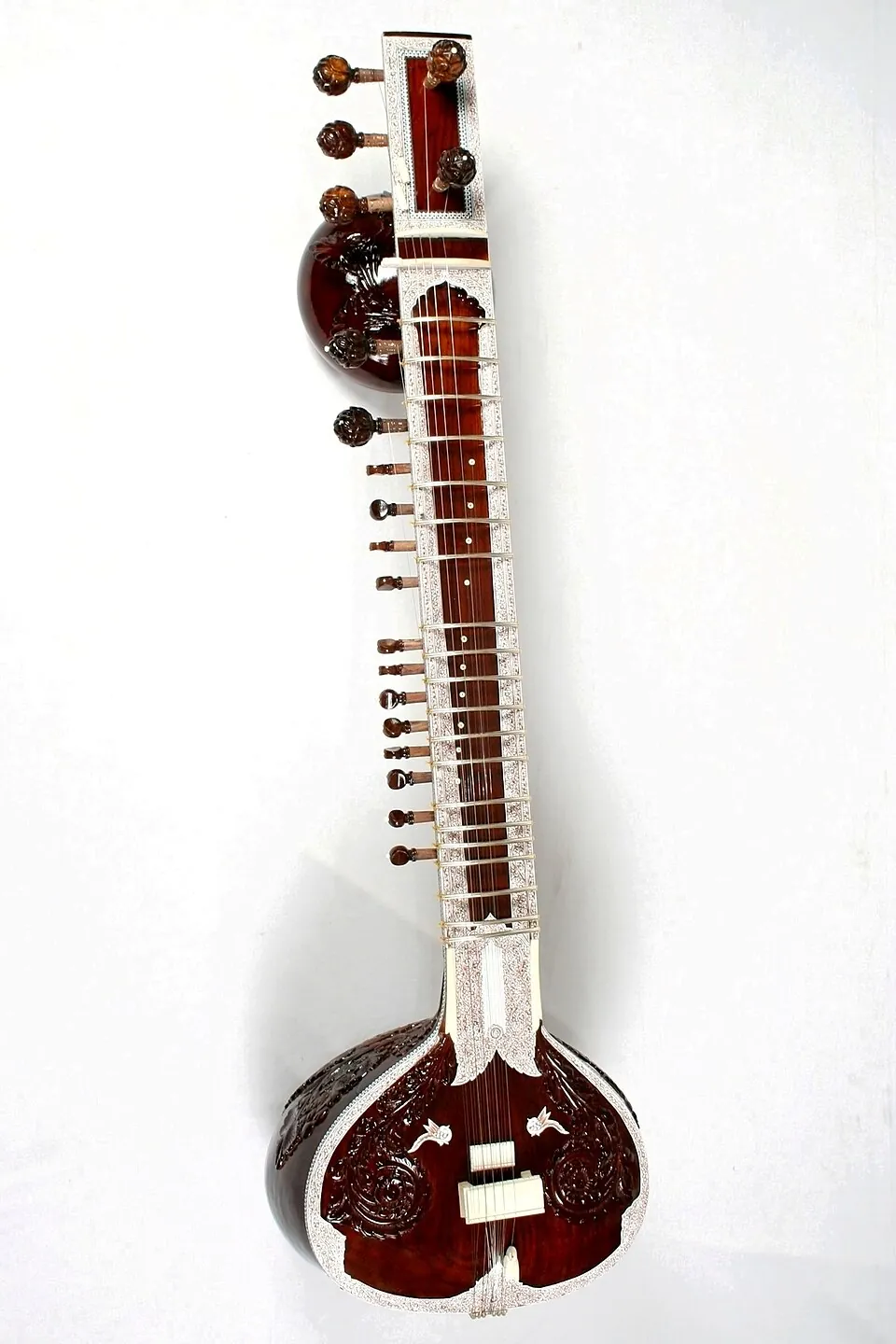
Ravi Shankar Takes the Sitar to a Global Audience
Sitāra · सितार
The sitar, a plucked string instrument of Hindustani classical music, reached its present form in the nineteenth century. From the late 1950s and early 1960s Pandit Ravi Shankar made it famous worldwide through concerts, recordings and collaborations. His work brought wide attention to Indian classical music.
The sitar is a plucked stringed instrument of the Indian subcontinent, central to Hindustani classical music. Modern scholarship holds that it was invented in the eighteenth century, with a figure named Khusrau Khan of the Mughal period identified as its originator, and that it took its present shape during the nineteenth century. Most historians think it descends from the Persian setar, an older three-stringed instrument. Although it had long been widely used across South Asia, the sitar became familiar to the wider world through Pandit Ravi Shankar, whose international career began in the late 1950s and early 1960s. His tours and recordings introduced Indian ragas to audiences in Europe and the United States, and his friendship with George Harrison of the Beatles and his 1967 appearance at the Monterey Pop Festival brought the instrument into popular culture. Many Western musicians took up the sitar after that, a development that opened broader interest in Indian classical music, though some Indian artists felt the result was shallow. The date given is an approximate marker for this global turn.