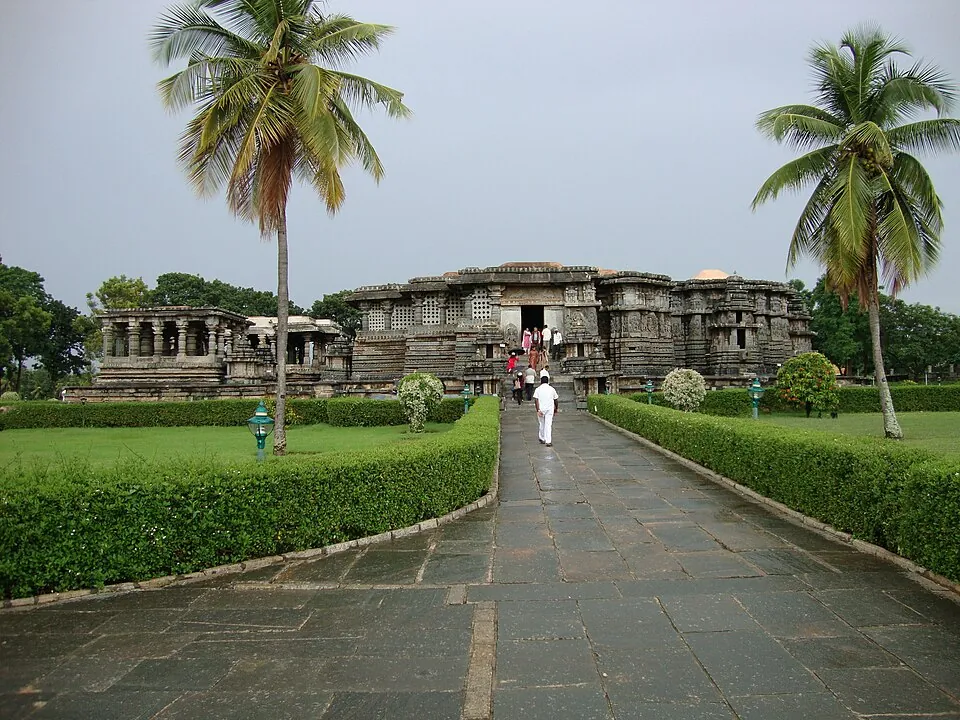
Hoysaleśvara Temple Rises at Halebidu
Hoysaḷeśvara · होयसळेश्वर
The Hoysaleśvara temple at Halebidu in Karnataka was begun around 1121 CE under King Viṣṇuvardhana and was complete by about 1160. Built beside a large artificial lake in the Hoysala capital, this Śaiva monument also embraces Vaiṣṇava and Śākta themes, and later fell into neglect after raids from Delhi.
The Hoysaleśvara temple, often called simply the Halebidu temple, is the largest monument in Halebidu, once the capital of the Hoysala Empire in present-day Karnataka. King Viṣṇuvardhana sponsored it, and work is dated from about 1121 CE to about 1160 CE. It was constructed on the bank of a large man-made lake, in a setting that tied royal power to water and devotion. Although the shrine is dedicated to Śiva, its sculpture draws respectfully on Vaiṣṇava and Śākta subjects as well, showing a religious outlook that welcomed several traditions under one roof. Halebidu lies about thirty kilometres from Hassan and roughly two hundred and ten kilometres from Bengaluru. In the early fourteenth century the town was sacked twice by armies of the Delhi Sultanate, after which the capital and its great temple declined into ruin and neglect. Together with the temples at Belur and Somanathapura, it is a leading example of Hoysala architecture, which received UNESCO World Heritage recognition in 2023.
Sources
- Hoysaleswara Temple Wikipedia · CC-BY-SA-4.0
- Q3517561 Wikidata · CC0-1.0