The Indo-Aryan Languages Take Shape
The Indo-Aryan languages form a branch of Indo-Iranian within Indo-European, now spoken by hundreds of millions across South Asia and in diaspora communities worldwide. Reconstructed Proto-Indo-Aryan differs little from Vedic Sanskrit, while the Prakrits preserve archaic traits Vedic dropped, so scholars date the branch's emergence to the second millennium BCE.
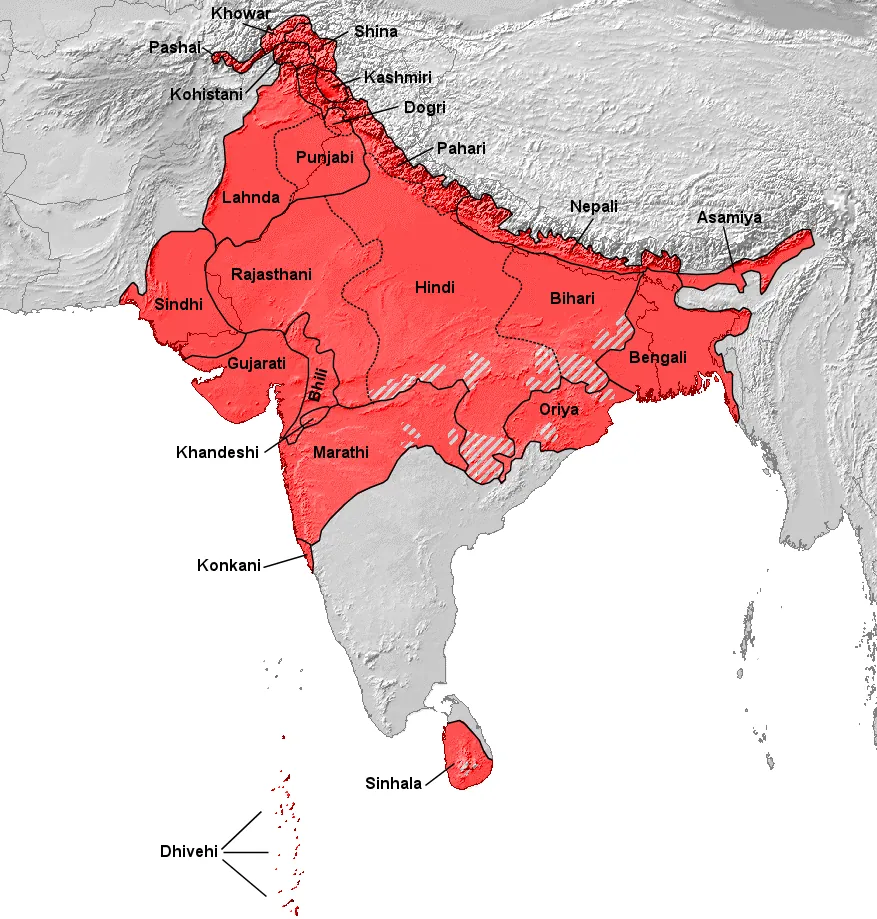
Indo-Aryan, sometimes called Indic, is a branch of the Indo-Iranian languages within the wider Indo-European family. It includes roughly two hundred languages, among them Hindi-Urdu, Bengali, Punjabi, Marathi, Gujarati, Sinhala and Romani, with several hundred million speakers today, concentrated east of the Indus but carried by migration to Europe, the Caribbean, Africa and elsewhere. Linguists reconstruct a Proto-Indo-Aryan stage nearly identical to Vedic Sanskrit, the language of the oldest hymns. The relationship is not a simple line of descent, however. Certain later Prakrits keep archaic traits absent from Vedic Sanskrit, which shows that they descend from a parallel form of Proto-Indo-Aryan and not from the Sanskrit of the Veda itself. Over the centuries Sanskrit, the Prakrits, Pali and the Apabhraṃśa stages gave way to the modern regional languages. The date used here, around 1500 BCE, is a scholarly approximation for the period when Old Indo-Aryan is first attested in the Ṛgveda; the branch itself is certainly older, and its precise origins remain debated.
Sources
- Indo-Aryan languages Wikipedia · CC-BY-SA-4.0
- Q33577 Wikidata · CC0-1.0