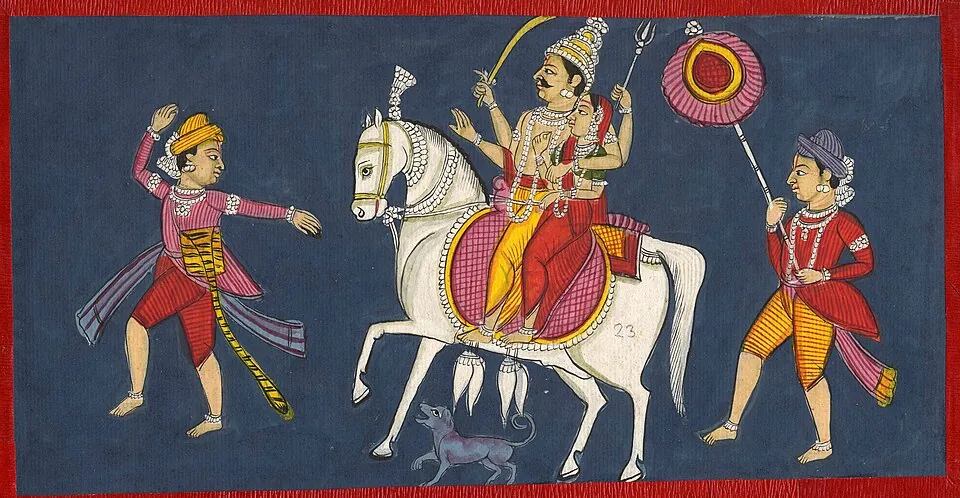
Khandobā, the Family God of the Deccan
Khaṇḍobā · खंडोबा
Loose marker for Maratha-era devotion; the folk cult is attested from the 12th century.
Khandobā, also called Mārtaṇḍa Bhairava and Malhāri, is a Deccan deity regarded as a form of Śiva and is the most popular family god in Maharashtra. His cult, recorded at least from the twelfth century, draws warriors, farmers, shepherds and priests, and welcomes people of every caste and also Muslims.
Khandobā, in Marathi Khaṇḍobā, is also known as Mārtaṇḍa Bhairava and Malhāri. Worshipped mainly across the Deccan, particularly in Maharashtra and Karnataka, he is treated as a manifestation of Śiva and is the most widely followed kuladevatā, or family deity, in Maharashtra. His devotees include Maratha warriors, farming and herding castes, some Brahmin families and several hunter-gatherer communities of the hills and forests. The cult shows connections with both Hindu and Jain traditions and is open to people of every community regardless of caste, Muslims among them. As a folk deity the sect goes back at least to the twelfth century, and Khandobā appears as a composite figure combining traits of Śiva, Bhairava, Sūrya and Kārttikeya. He is sometimes identified with Mallanna in Telangana and Andhra Pradesh and with Mailāra in Karnataka. The year 1600 is only a loose marker for the period of strong Maratha-era devotion, and the origins lie much earlier. As a living cult with songs, festivals and pilgrimage, it demonstrates how regional belief can bring varied groups into a shared religious life.