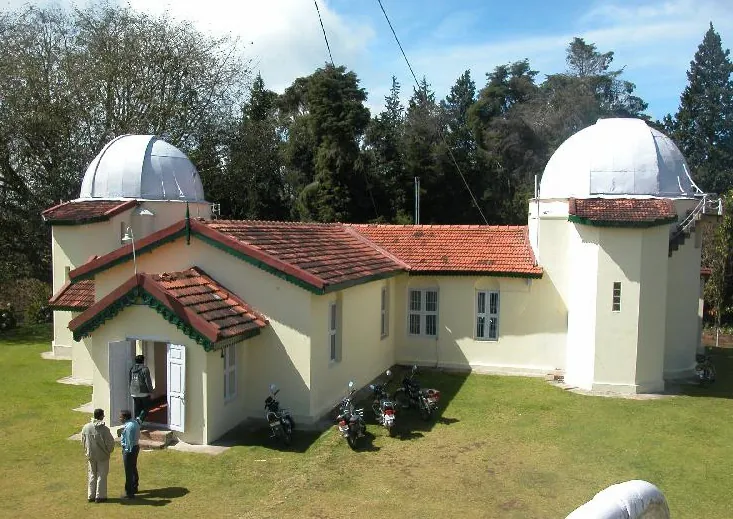
Kodaikanal Solar Observatory Begins Observing
The Kodaikanal Solar Observatory, on the southern edge of the Palani Hills, started work in 1899 and holds the longest continuous series of solar data in India. There the Evershed effect was first detected in 1909. It is now run by the Indian Institute of Astrophysics.
Kodaikanal Solar Observatory stands at the southern end of the Palani Hills in Tamil Nadu, about four kilometres from the hill town of Kodaikanal. Established in 1899, it now belongs to the Indian Institute of Astrophysics, which runs it. Its main distinction is the record it has kept: the solar observations collected there form the oldest unbroken series of their kind in India, which makes them precious for studying long-term changes in the Sun. In January 1909 astronomer John Evershed noticed at this site the radial flow of gas in sunspots, now called the Evershed effect. The location also offers special conditions for studying the equatorial electrojet, a current in the upper atmosphere, because of its position near the magnetic equator. Regular measurements are made of the ionosphere, the geomagnetic field and surface conditions, and summaries are sent to Indian and international data centres, including the India Meteorological Department and the World Meteorological Organization. The staff is small, with two scientists and three technicians at last count.
Sources
- Kodaikanal Solar Observatory Wikipedia · CC-BY-SA-4.0
- Q3348492 Wikidata · CC0-1.0