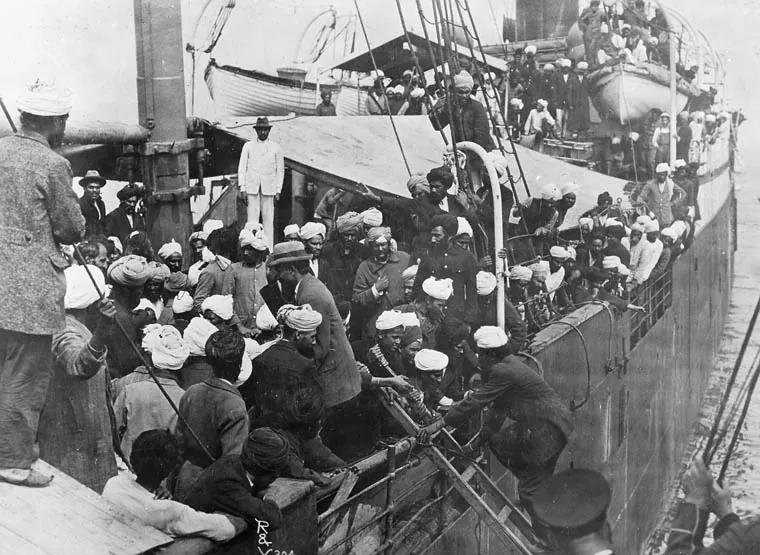
The Komagata Maru Is Turned Away at Vancouver
Komagata Maru · कोमागाटा मारू
On 23 May 1914 the Japanese steamship Komagata Maru, carrying 376 Punjabi passengers, mostly Sikhs, was denied entry at Vancouver under Canada's continuous journey rule. Held offshore for two months, it was forced back to India, where violence at Budge Budge followed.
On 23 May 1914 the Japanese steamship Komagata Maru, which its passengers called Guru Nanak Jahaz, was refused permission to land its passengers at Vancouver in British Columbia, in a dispute over immigration. The 376 travellers, all British subjects from Punjab, included roughly 340 Sikhs along with 24 Muslims and 12 Hindus. Most were barred under Canada's continuous journey regulation, which in practice excluded migrants from India, and authorities also suspected links to revolutionary groups in India. The ship stayed in the harbour for two months while the passengers, supported by the local community, fought for their right to enter in the courts and in public meetings, and only a small number were admitted. In July it was escorted out of Canadian waters. On its return to Calcutta in September, police tried to arrest the leader Gurdit Singh and clashed with passengers at Budge Budge, where about twenty people died. The episode became a landmark in the history of Indian and Canadian migration and fed the anti-colonial Ghadar movement. In 2016 the Canadian prime minister formally apologised in Parliament for the government's role.
Sources
- Komagata Maru incident Wikipedia · CC-BY-SA-4.0
- Q6428056 Wikidata · CC0-1.0