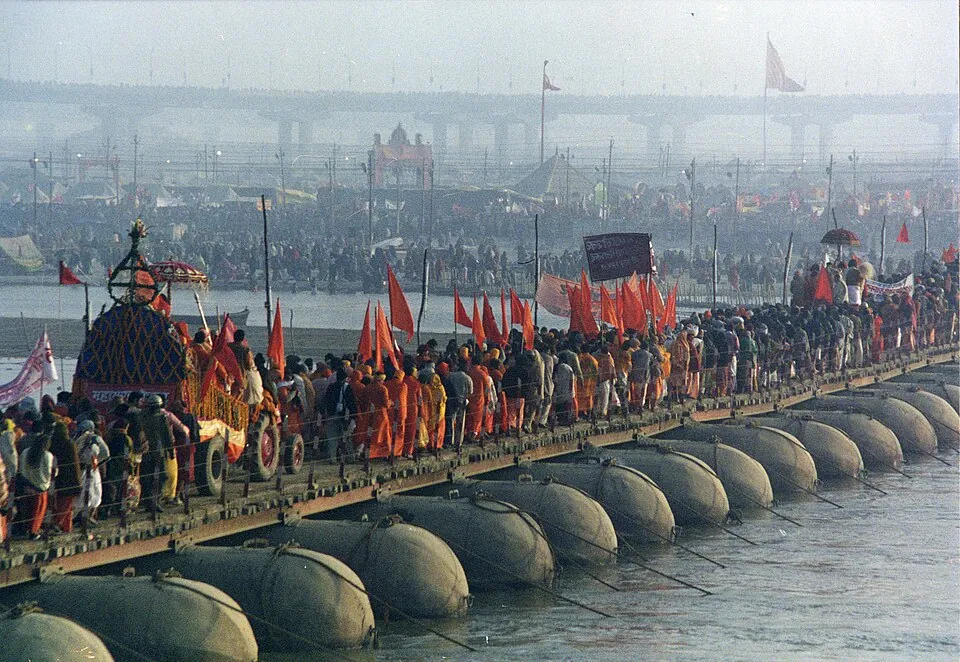
The Kumbh Mela Draws Record Crowds at Prayagraj
Kumbha Melā · कुम्भ मेला
The Kumbh Mela is a Hindu pilgrimage held at Prayagraj, Haridwar, Nashik and Ujjain on a cycle tied to Jupiter, rooted in the Puranic story of nectar drops. In 2025 about 660 million attended, the largest gathering anywhere, and the festival is on UNESCO's heritage list.
Called the festival of the sacred pitcher, the Kumbh Mela is a Hindu pilgrimage that recurs every four or twelve years, following Jupiter's motion. It takes place at four sites: Prayagraj, Haridwar, Nashik and Ujjain. The Purāṇas say that drops of amṛta, the divine nectar, fell at these places during the Samudra Manthana, the churning of the ocean of milk. The festival lasts from one to three months, and the new moon day, Amāvasyā, draws the biggest crowds. It runs on a roughly twelve-year cycle at each site, set by the Hindu luni-solar calendar and by how Jupiter, the Sun and the Moon stand relative to one another, whose particular alignments are believed to occur only at the four locations. The Prayagraj and Haridwar gatherings come six years apart. Millions attend, and the largest crowds are recorded at Prayag, where roughly 660 million people were reported in 2025, compared with 240 million at the 2019 event, the biggest human gathering anywhere. The festival is inscribed on UNESCO's list of intangible cultural heritage. The date used here marks the 2025 gathering, though the pilgrimage itself has a much older tradition rooted in sacred narrative.
Sources
- Kumbh Mela Wikipedia · CC-BY-SA-4.0
- Q10283 Wikidata · CC0-1.0