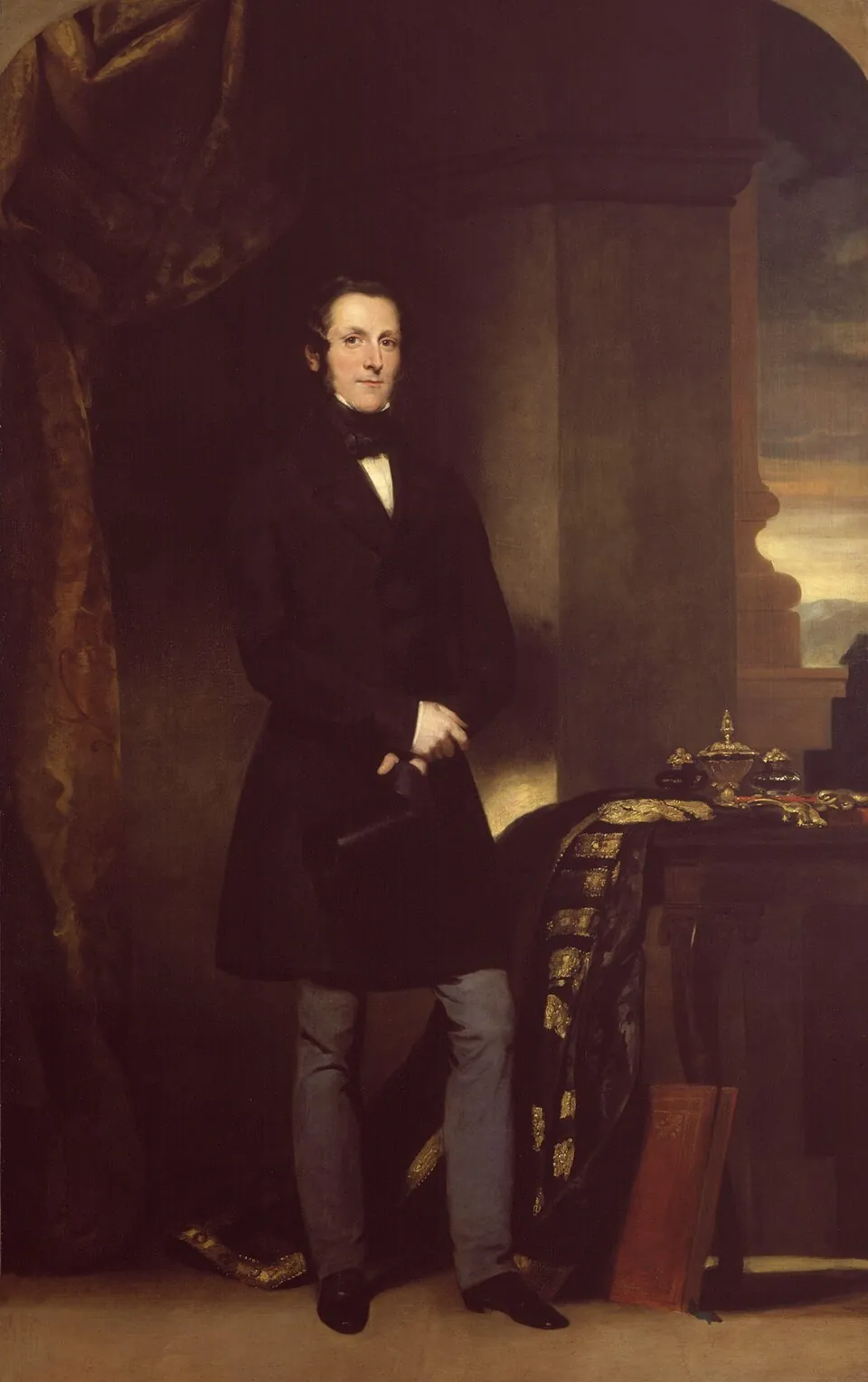
Dalhousie's Governor-Generalship Reshapes British India
Lord Dalhousie · लॉर्ड डलहौज़ी
The Marquess of Dalhousie was Governor-General between 1848 and 1856. He laid foundations of the colonial education system, introduced passenger railways, the electric telegraph and uniform postage, and annexed territories, including the Punjab and states under the Doctrine of Lapse, in ways that deepened discontent.
James Andrew Broun-Ramsay, the Marquess of Dalhousie, was a Scottish statesman who held the office of Governor-General in India between 1848 and 1856. He was a vigorous modernizer. He helped lay the foundations of the colonial educational system by adding mass education to the existing elite higher education, and he introduced passenger railways, the electric telegraph and a uniform postal system, which together knitted the subcontinent more closely. Public works such as the Grand Trunk Road and the Ganges Canal were also advanced during his term. He was just as energetic in expanding British territory. After the Second Anglo-Sikh War he annexed the Punjab in 1849, and he used the Doctrine of Lapse, which refused to recognise adopted heirs of Indian rulers, to absorb states such as Satara, Jhansi and Nagpur, while Awadh was taken in 1856 on grounds of misgovernment. These measures angered many rulers and their subjects, and historians commonly count them among the long-term causes of the rebellion of 1857, which broke out soon after he left. His record therefore combines administrative reform with an aggressive imperial policy, and it is judged very differently by different scholars.
Sources
- James Broun-Ramsay, 1st Marquess of Dalhousie Wikipedia · CC-BY-SA-4.0
- Q333117 Wikidata · CC0-1.0