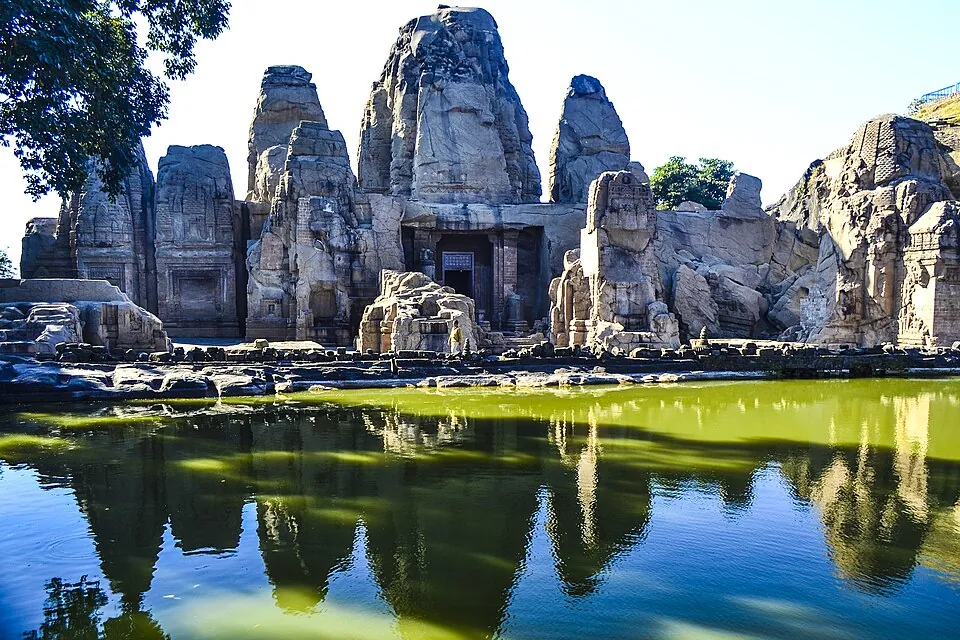
Masrur Rock-Cut Temples in the Kangra Valley
Masrūr Mandira · मसरूर मंदिर
The Masrur temples are an early eighth-century group of Hindu shrines cut from rock in the Kangra Valley of Himachal Pradesh, facing the Dhauladhar range. Built in the northern Nāgara style, they honour Śiva, Viṣṇu, Devī and the Sun, and the complex was never finished.
The Masrur temples, also spelled Masroor, are a set of Hindu temples carved from the rock in the valley of the Beas river in the Kangra area of Himachal Pradesh. They are dated to the early eighth century CE. The shrines face north-east, towards the Dhauladhar range of the Himalayas, and are cut from monolithic rock into the form of northern Nāgara temples with curvilinear towers. They are dedicated to Śiva, Viṣṇu, the Goddess and the Sun, and the surviving imagery suggests a worldview in which several deities were honoured together. Archaeological study indicates that the builders planned something far more ambitious, and the complex was left incomplete. Much of the sculpture and relief work has been lost, and the buildings have been badly damaged, most likely by earthquakes. A sacred pool was provided in front, as prescribed in Hindu temple treatises. The group is often compared to the rock-cut temples at Ellora, which it recalls, though it is in an unusual Himalayan setting. The date given is an architectural estimate based on style, since no inscription fixes the year.
Sources
- Masrur Temples Wikipedia · CC-BY-SA-4.0
- Q19893793 Wikidata · CC0-1.0