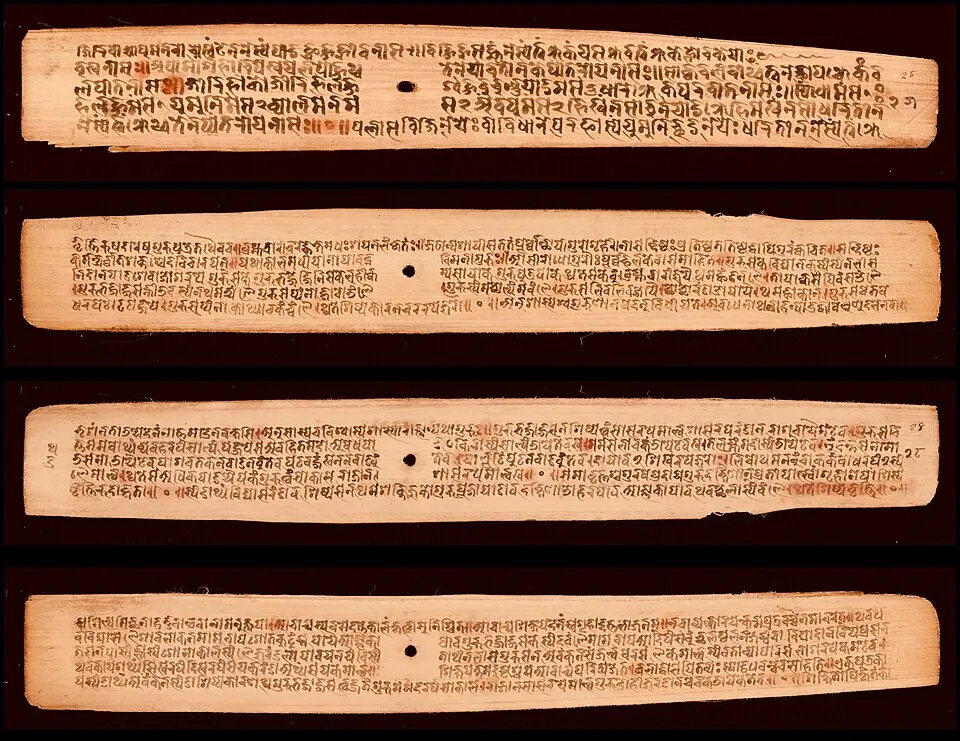
The Nāradasmṛti, a Law Code of Procedure
Nāradasmṛti · नारदस्मृति
The Nāradasmṛti is a Dharmaśāstra text focused only on law and court procedure, which sets it apart from works mixing law with conduct and penance. Rulers in the subcontinent and Southeast Asia valued it. Scholars usually place it in the Gupta period.
Among the Sanskrit Dharmaśāstra works, the Nāradasmṛti stands out because it is purely juridical. Where other texts blend legal rules with sections on righteous conduct, purification and atonement, this one deals exclusively with procedural and substantive law, including debts, deposits, partnership, inheritance, theft and the conduct of trials, which led scholars to call it the juridical text par excellence. It is attributed to the sage Nārada, and a probable date around the fourth or fifth century CE is commonly given, so it is associated with the Gupta age. Rulers and their officials found it useful as a guide to administering justice, since upholding law was seen as a king's duty, and it was used well beyond the subcontinent, notably in Southeast Asian kingdoms that adopted Sanskrit legal learning. Later commentators, among them those of the Mitākṣarā tradition, cited it frequently. The text offers an important view of how courts and legal ideas were imagined in classical India, though historians stress that its prescriptions describe an ideal system and may not match what actually happened in every region.
Sources
- Nāradasmṛti Wikipedia · CC-BY-SA-4.0
- Q4313040 Wikidata · CC0-1.0