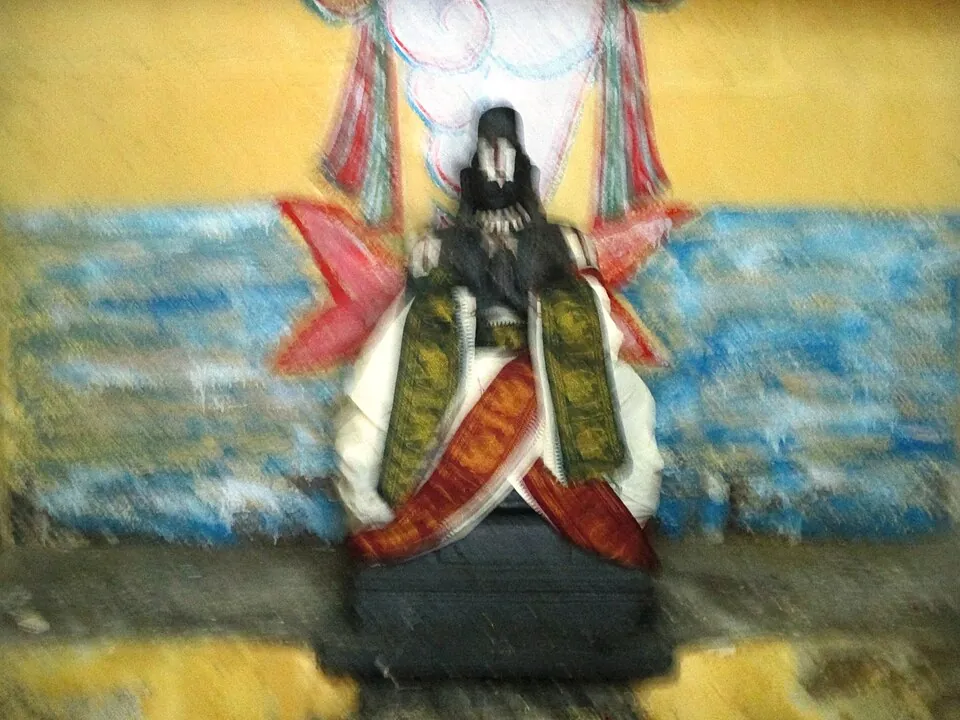
Poygai Āḻvār, First of the Mutal Āḻvārs
Poygai Āḻvār · பொய்கையாழ்வார்
Poygai is counted among the twelve Āḻvār saints of Tamil Vaiṣṇavism and, with Bhūtattāḻvār and Pēyāḻvār, as one of the three earliest. His hundred verses, the Mutal Tiruvantāti, stand at the opening of the devotional corpus later gathered as the Nālāyira Divya Prabandham, a foundation for Tamil Vaiṣṇava worship.
Poygai Āḻvār belongs to the twelve Āḻvārs, the Tamil poet-saints of Vaiṣṇava devotion whose songs form the Nālāyira Divya Prabandham and whose praised temples are known as the 108 Divya Deśams. With Bhūtattāḻvār and Pēyāḻvār he forms the Mutal Āḻvārs, the first three. Legend says he was found in a small pond, a poygai in Tamil, near a temple at Tiruvekkā, which gave him his name. Another story tells that the three saints sheltered together from rain in a narrow room at Tirukkōvalūr and sensed a fourth presence, which they recognised as Viṣṇu; Poygai sang a hundred verses asking for light so that the vision could continue. These make up the Mutal Tiruvantāti, composed in antāti style, where the last syllable of one verse begins the next. Tradition places the earliest Āḻvārs in the Dvāpara Yuga, before 4200 BCE, but historians usually assign them to the sixth or seventh century CE, which is the approximate date given here. The legends belong to sacred narrative, not documented history.
Sources
- Poigai Alvar Wikipedia · CC-BY-SA-4.0
- Q3790097 Wikidata · CC0-1.0