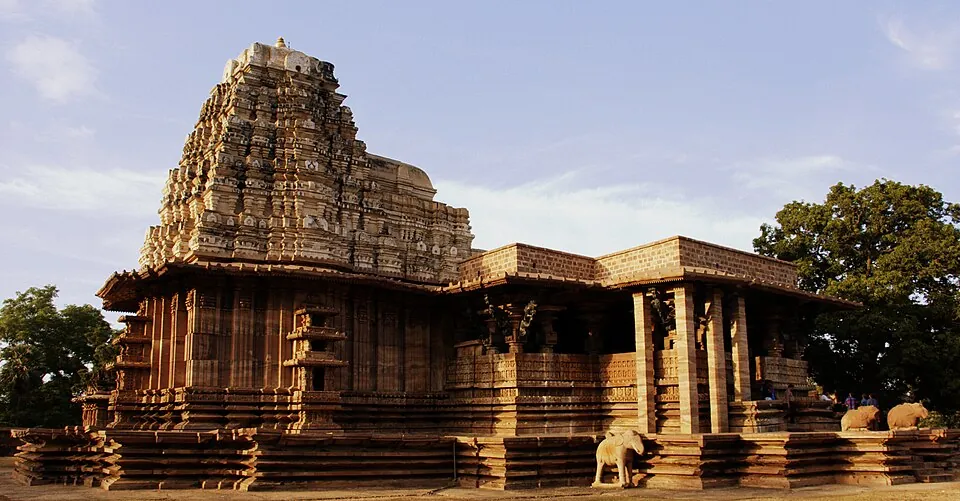
Ramappa Temple Rises at Pālampet
Rāmappa Mandir · రామప్ప దేవాలయం
The Ramappa, or Rudreśvara, Temple at Pālampet in Telangana was commissioned in 1213 by the Kākatīya general Recherla Rudra and took about forty years to build. Dedicated to Śiva, it blends Dravidian and Chalukyan styles and uses light bricks and a sandbox foundation.
The Rudreśvara Temple, better known as the Ramappa Temple, is found at the village of Pālampet, in the east of Telangana. An inscription on a basalt pillar in a nearby courtyard records that Recherla Rudra, a general of the Kākatīya dynasty, commissioned it in 1213, and that construction continued for roughly four decades under Gaṇapati, the third Kākatīya ruler. Dedicated to Śiva, it is a leading example of Kākatīya architecture and joins features of Dravidian and Chalukyan design. The walls and platform use red sandstone, while its richly carved pillars and brackets are of granite and dolerite. Distinctive engineering features include a vimāna built of light clay bricks that are said to float, and a foundation of sand-filled design meant to absorb the energy of earthquakes. Malik Kāfūr's attack on Warangal in 1310 caused only minor harm, though the temple declined after the Kākatīya fall. Ghulam Yazdani surveyed and restored it in 1916, and the Archaeological Survey of India took over its care in 1948. The wider complex includes several partly ruined structures.
Sources
- Ramappa Temple Wikipedia · CC-BY-SA-4.0
- Q3380656 Wikidata · CC0-1.0