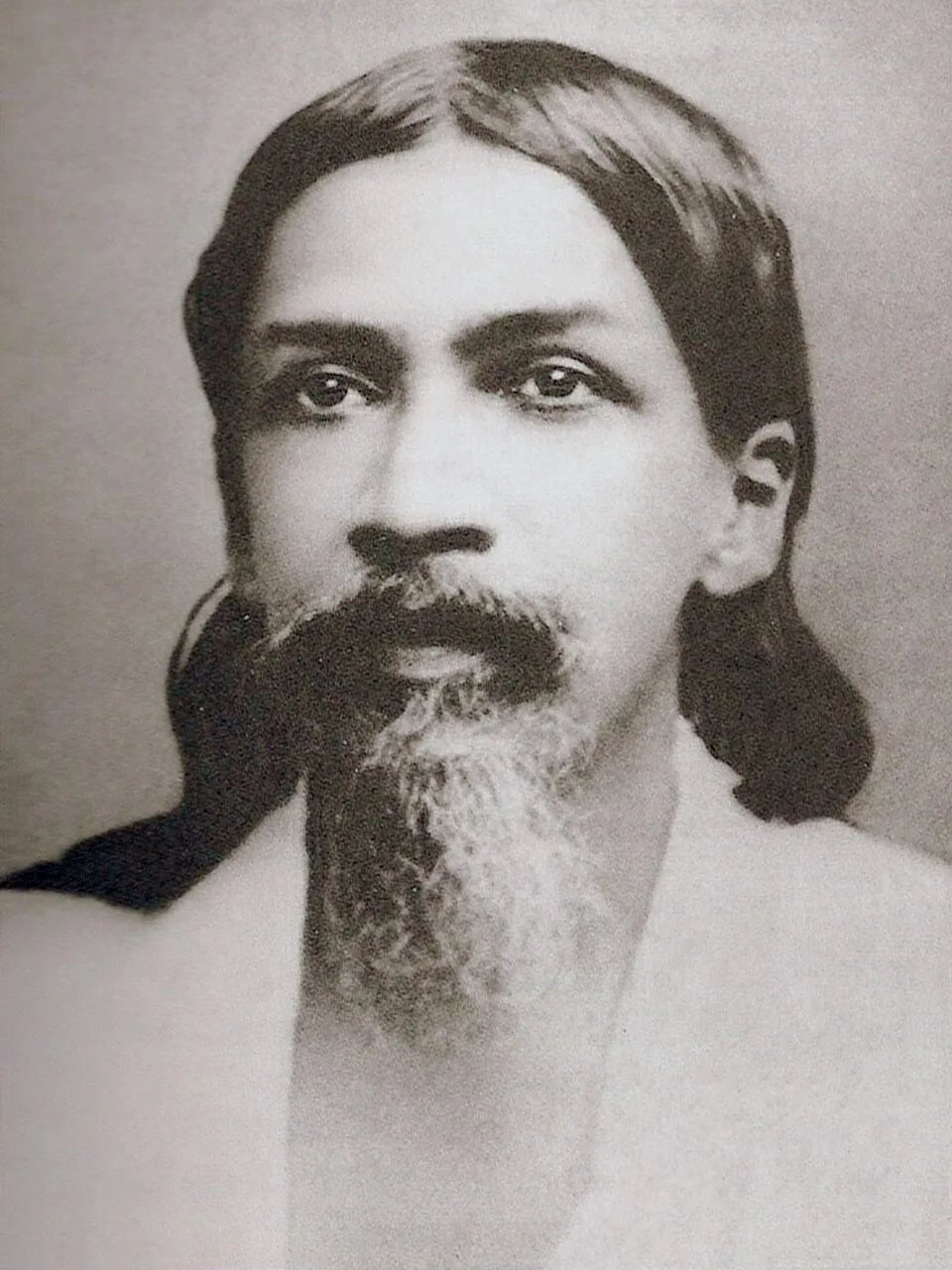
Sri Aurobindo Withdraws to Pondicherry
Śrī Aurobindo · श्री अरविन्द
Sri Aurobindo (1872 to 1950), a nationalist leader acquitted in the Alipore Conspiracy trial, left politics for Pondicherry in 1910 and devoted himself to spiritual practice. There he developed Integral Yoga and wrote The Life Divine, The Synthesis of Yoga and the epic Savitri.
Born Aurobindo Ghose on 15 August 1872, he studied at King's College, Cambridge, preparing for the Indian Civil Service, and returned to India in 1893 to work for the Maharaja of Baroda. He grew increasingly drawn to nationalist politics through the Indian National Congress and the young revolutionary movement in Bengal, where he was linked to the Anushilan Samiti, and he argued in print for complete independence. After a series of bombings associated with that circle he was arrested and tried for treason in the Alipore Conspiracy case, and was acquitted. In 1910 he moved to Pondicherry, then a French territory, to concentrate on spiritual work, shaping a path he called Integral Yoga. His philosophical masterwork, The Life Divine, sets out its metaphysical basis, while The Synthesis of Yoga explains its principles and methods. He also composed the long epic poem Savitri. In 1926 he withdrew further into seclusion while his collaborator Mirra Alfassa, known as the Mother, organised the growing community that became the Sri Aurobindo Ashram. He died on 5 December 1950.
Sources
- Sri Aurobindo Wikipedia · CC-BY-SA-4.0
- Q192207 Wikidata · CC0-1.0