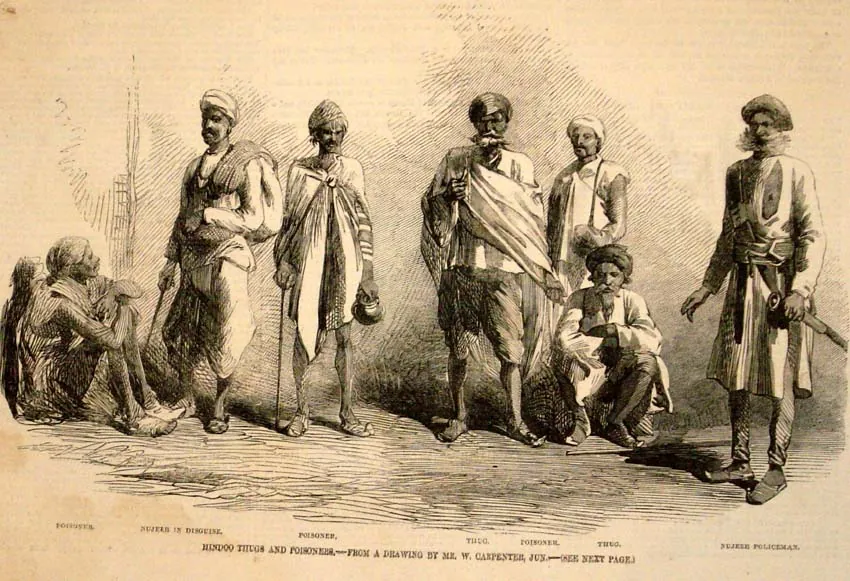
Thuggee and the Campaign Against the Thugs
Thuggee was a form of highway robbery in which gangs killed travellers, often by strangling. In the 1830s William Sleeman led a colonial campaign against it. Modern historians reject the British image of an ancient secret cult, seeing the Thugs as largely ordinary criminals.
Thuggee refers to gangs of robbers who murdered and plundered travellers on the roads of the subcontinent, typically by strangling them. Under East India Company rule it was portrayed as a secret fraternity of ritual killers with ancient roots, driven by religious fanaticism. Since the 1950s historians have challenged that picture, arguing that religion played little part and that the Thugs were closer to ordinary bandits, so that the widespread view among contemporary scholars is against the colonial account. The problem rose to official attention in the early nineteenth century as Company territory spread and as new roads and trade routes drew attention to the dangers of travel. In the 1830s the administrator William Henry Sleeman directed a policing drive, aided by new laws that made convictions easier, and in 1835 a dedicated Thuggee Department was set up. The year 1830 is used here as a rough marker for the height of the campaign. The episode matters because it shows how colonial categories, and later popular fiction, shaped lasting stereotypes of India.