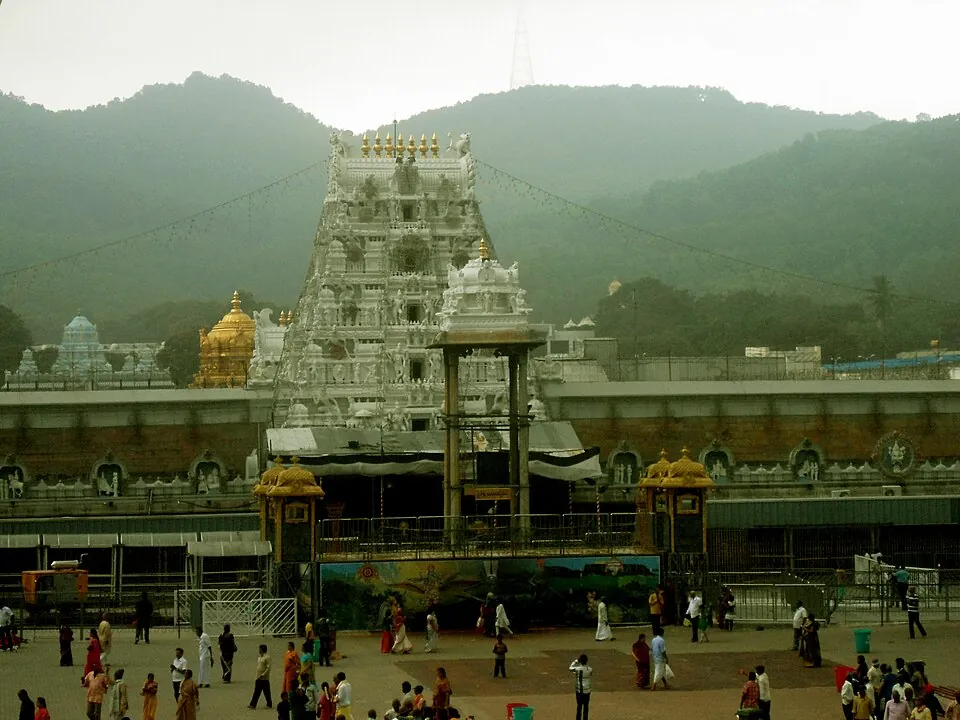
Venkateswara Temple on the Seven Hills of Tirumala
The Venkateswara temple crowns the seventh peak of the Tirumala range in Andhra Pradesh. Devotees see its deity as Vishnu appearing for the Kali age. Tradition credits early Tondaiman rulers with its founding, and Chola, Pandya and Vijayanagara patrons later enlarged the Dravidian-style complex now run by the Tirumala Tirupati Devasthanams.
Perched at roughly 980 metres in the Seshachalam hills, the Tirumala shrine stands on Venkatadri, the last of seven peaks that local belief likens to the heads of the serpent Adisesha. Its presiding deity, known as Venkateswara, Balaji, Govinda or Srinivasa, is understood by worshippers as a form of Vishnu who came to earth to relieve the troubles of the present Kali age, which is why the site is also called Kaliyuga Vaikuntha. The temple lies beside the sacred tank Swami Pushkarini. Tradition attributes its origins to the Tondaiman rulers, and inscriptions and later history record expansion and reform under the Cholas, the Pandyas and the Vijayanagara kings, who left the present Dravidian architectural character. The date given here is a rough marker for the early medieval growth of the shrine rather than a founding year. Today an autonomous body, the Tirumala Tirupati Devasthanams, appointed under the Andhra Pradesh government, manages the temple, and it ranks among the most visited places of worship in the world.
Sources
- Venkateswara Temple, Tirumala Wikipedia · CC-BY-SA-4.0
- Q9375937 Wikidata · CC0-1.0