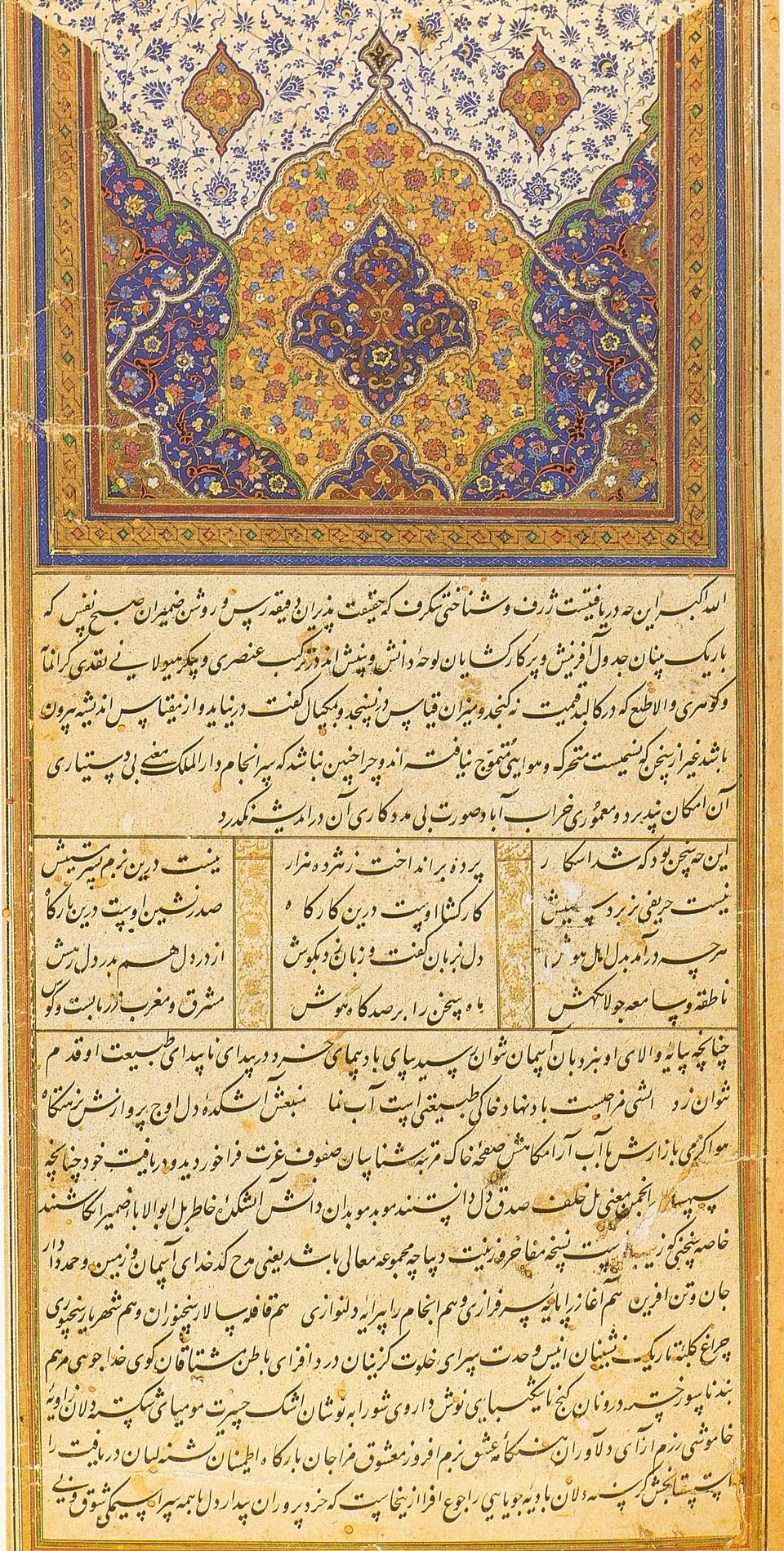
Abū'l-Faḍl Completes the Akbarnāma
Akbarnāma · अकबरनामा
The Akbarnāma is the official Persian chronicle of the reign of the Mughal emperor Akbar, commissioned by him and written chiefly by his court historian Abū'l-Faḍl. Work began about 1589 and reached its form by 1598. Its vivid narrative and companion Āʾīn-i-Akbarī are prime sources for the period.
The Akbarnāma, or Book of Akbar, is the court history of the third Mughal emperor, whose reign ran from 1556 to 1605. Akbar himself commissioned it, and his court historian and friend Abū'l-Faḍl wrote most of it, beginning around 1589 and completing the main narrative about 1598. It was composed in Persian, the literary language of the Mughal court, and offers detailed and often vivid accounts of the emperor's life and times, from the ancestry of the dynasty and Akbar's birth through the campaigns, administrative measures and religious discussions of his reign. It followed the Bābarnāma, the more personal memoir of Akbar's grandfather Bābur, the dynasty's founder, but is a very different kind of work, shaped by a court purpose of presenting the ruler as an ideal sovereign. Abū'l-Faḍl also wrote the Āʾīn-i-Akbarī, a survey of the empire's institutions, statistics and customs that forms the last part of the larger project. Copies were illustrated by court painters, giving some of the finest Mughal miniatures. Historians treat the text as invaluable but also as panegyric, to be checked against other sources.