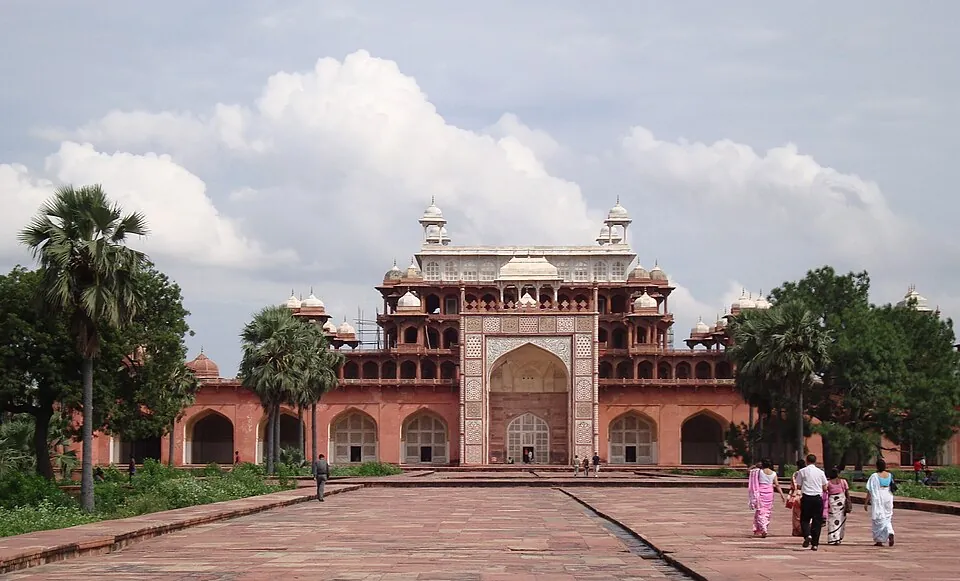
Jahāngīr Completes Akbar's Tomb at Sikandra
Akbar's mausoleum at Sikandra, near Agra, was built between 1605 and 1613 by his son Jahāngīr. Set in extensive grounds of about 119 acres, its buildings are made mainly of deep red sandstone enriched with decorative elements in white marble.
The tomb of Akbar, the third Mughal emperor, stands at Sikandra, a suburb of Agra in Uttar Pradesh. Construction ran from 1605 to 1613 under his son and successor Jahāngīr, so the work began soon after Akbar's death. The mausoleum sits in grounds covering about 119 acres, laid out as a garden in the Mughal manner. The principal material is deep red sandstone, set off with decoration in white marble, which gives the complex a bold colour contrast compared with the all-white marble look associated with later Mughal monuments. Wikidata gives 1604 as the inception year, so sources differ by a year on the start. Placed beside the great fort and palace city at Fatehpur Sikri that Akbar himself built, the tomb provides a monument to his reign, and its design is often discussed as a bridge between the earlier tombs of Humāyūn and the later Tāj Mahal. Today the site is a major attraction near Agra and an important example of early seventeenth-century Mughal architecture.
Sources
- Akbar's tomb Wikipedia · CC-BY-SA-4.0
- Q416646 Wikidata · CC0-1.0