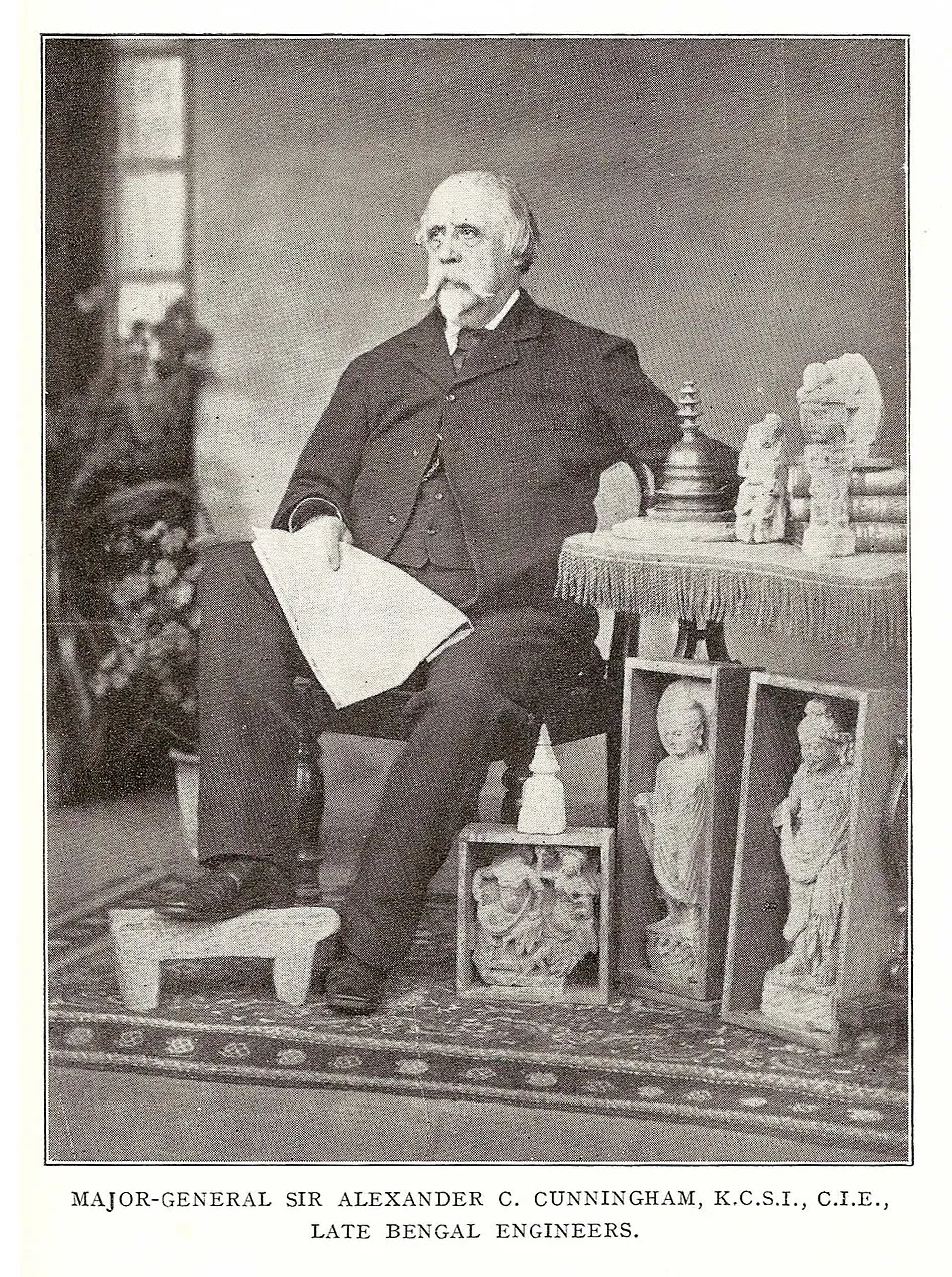
Cunningham Founds the Archaeological Survey
Alexander Cunningham · अलेक्ज़ैंडर कनिंघम
In 1861 Alexander Cunningham, a Bengal Engineers officer with a deep interest in India's past, was appointed archaeological surveyor to the government of India. He organised the body that became the Archaeological Survey of India and recorded major Buddhist and early historic sites.
Alexander Cunningham, born in 1814, served as an engineer officer with the Bengal Sappers and became deeply absorbed in the past and the antiquities of the subcontinent. In 1861 the government created for him the new post of archaeological surveyor, and from it he founded and organised the institution that grew into the Archaeological Survey of India. His surveys covered a vast area and gave systematic descriptions and maps of ancient sites, working in part with the accounts of Chinese pilgrims such as Xuanzang and Faxian to identify places. He took part in the study of Sārnāth, Sāñcī, Bodh Gayā and Bhārhut, and he helped to recover the inscriptions of Aśoka, publishing the first volume of the Corpus Inscriptionum Indicarum in 1877. He published many books and monographs and amassed large holdings of coins and antiquities, parts of which later entered the British Museum. His methods were often those of his day, and modern scholars note both his remarkable energy and the limits of his interpretations, including some wrong identifications. Even so, his work gave Indian archaeology an institutional base and a first framework for the study of early Indian history.
Sources
- Alexander Cunningham Wikipedia · CC-BY-SA-4.0
- Q455430 Wikidata · CC0-1.0